
uJAM Cinedream for macOS
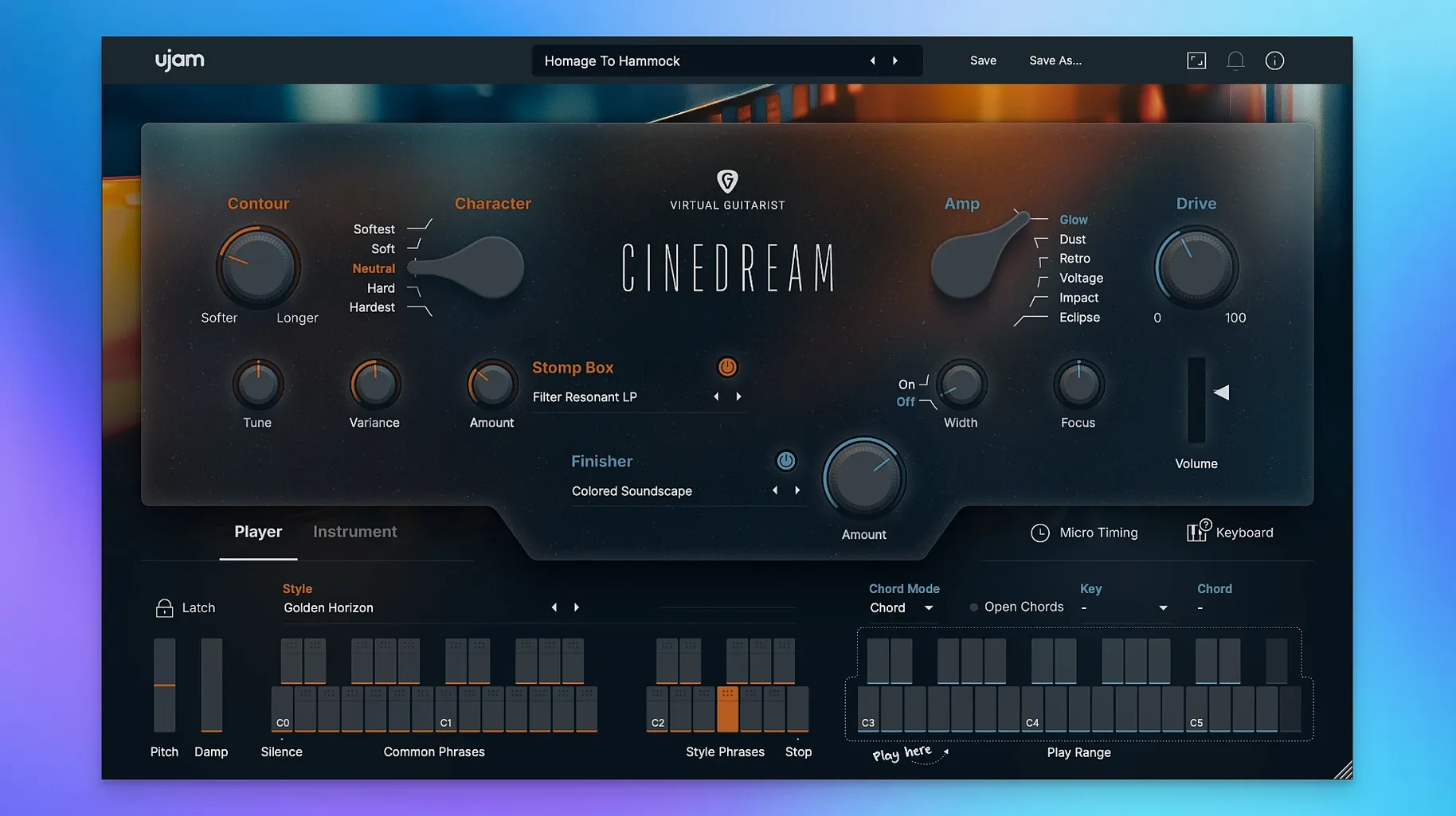
UJAM Cinedream is a virtual guitarist built to produce the kind of slow-moving, cinematic textures that sit behind dialogue or stretch across a scene transition.
Press a key for an evolving guitar cue
- Track stack for a cue. Load Cinedream on a software instrument track. Pick a style close to the mood you need — the chord trigger system starts an evolving guitar phrase as soon as you press a key, so you can try three or four styles before the picture has looped back around.
- Parallel bus for width. Send the dry output to a bus with a long reverb and a touch of saturation. The plugin's own tone control can go from soft and clean to rougher, slightly driven textures, so you can split the difference: keep the direct signal clean and let the bus carry the grit.
- Pad layering under synths. Pull the guitar back in the mix behind a soft synth pad. Because the parts evolve automatically, the guitar keeps moving without drawing attention — useful when the arrangement needs motion but not a melody.
It shows up as VST2, VST3, AU2 and AAX, and it runs natively on Apple silicon or through Rosetta on Intel Macs from macOS 10.13 onward. A ready-made style set covers ambient, soundtrack and emotional territory right out of the box, so you're rarely starting from an empty patch.
Suspended, weightless — not sad
Picture a sound designer working on a short film at 1 a.m. The director wants the moment where the protagonist stares out a rain-streaked window to feel suspended — not sad, exactly, but weightless. Opening Cinedream on an instrument track, they load the softest style they can find and hold a D minor chord. The guitar doesn't strum; it swells, moving through harmonics that shift almost imperceptibly as the chord trigger evolves the part. A touch of the onboard space effect pushes it toward the back of the stereo field. Ten minutes later the cue is locked, and the designer bounces the stem straight into the timeline without reaching for a single external processing chain.
That's the niche Cinedream fills: not a guitar you play, but a texture engine that happens to use a real guitar as its source. When the clock says you should have stopped working an hour ago, a plugin that responds to a single chord with a finished-sounding bed of ambience earns its place in the folder.
Drop it on a software instrument track in Logic, Live or Cubase
On a Mac, Cinedream sits comfortably inside Logic Pro, Ableton Live, Cubase or any AU- or VST3-compatible host. Because it's an instrument rather than an effect, dragging it onto a software instrument track immediately gives you a sound source you can route anywhere in your session — side-chain it to a compressor listening to the dialogue bus, send it to Space Designer for convolution reverb, or bounce it in place with Logic's real-time bounce for quick stems.
It also plays well with macOS-level routing tools. Create a multi-output device in Audio MIDI Setup.app and you can feed Cinedream's output into a separate application like Audacity for quick recordings without leaving your DAW. The AU2 version means it loads in the Mac's system audio units host, which some field recordists use inside apps like Triumph or TwistedWave for layering texture under location audio during editing passes.
The chord trigger approach pairs naturally with MIDI region looping in Logic or Ableton: draw a single long chord in a region, loop it for eight minutes, and let the virtual guitarist handle the evolving performance while you focus on the orchestra or the foley. For users who keep their sound libraries on external drives, the VG-CINEDREAM data folder under /Library/Application Support/UJAM/ can be symlinked to an external SSD — macOS handles the redirect transparently, and Cinedream doesn't complain about the path.
Pattern-based strumming versus evolving beds
Three other virtual guitar instruments overlap with Cinedream's territory, though each leans in a different direction.
Session Guitarist Electric Sunburst (Native Instruments) gives you a deeply sampled electric guitar with pattern-based strumming and picking. It's more versatile for lead lines and realistic rhythm parts, but it expects you to shape the performance phrase by phrase. Cinedream trades that control for immediacy: where Electric Sunburst asks you to program a pattern, Cinedream gives you a mood and a chord trigger and gets out of the way. The NI plugin needs Kontakt or the free Kontakt Player; Cinedream runs as a standalone instrument with no sampler host required.
Ambient Guitar (Sample Logic) leans heavily into sound design, with multi-layered arpeggiators and a morphing engine that can turn a guitar into something unrecognizable. It's powerful but dense — the interface rewards deep menu-diving. Cinedream strips that back to a handful of style presets and a tone knob. For a composer who wants a pad in thirty seconds, the simpler interface wins. For someone building a complex evolving instrument from scratch, Sample Logic offers more raw material.
Cinematic Guitars (Impact Soundworks) is a Kontakt library built for trailer music and dramatic scoring, with phrases, loops and individual articulations. It covers more aggressive territory — distorted pulses, ostinatos, risers — that Cinedream doesn't attempt. Where Cinematic Guitars pushes toward the front of a mix, Cinedream sits in the background, and a user might reasonably own both without overlap: one for tension and impact, the other for atmosphere and space.
Built to build cues against a timeline
Film and game composers working to picture benefit the most, because the plugin's core behavior — press a key, get an evolving bed — aligns with the way cues are built against a timeline. It's also a strong fit for ambient music producers who layer guitar textures under synth washes, since the automatic evolution prevents the static loop feeling that sampled pads can develop after a few repetitions.
Sound designers who need quick atmospheric filler for backgrounds or transitional moments will find it useful, particularly when a scene calls for something organic but not identifiably "a guitar." The tone control's ability to push the signal from clean into saturated territory means you can mangle the output further with distortion or bit-crushing — or leave it pristine for delicate underscore. Beginners who find traditional virtual guitar instruments intimidating benefit from the style-based approach, while experienced producers can use it as a scratchpad for texture ideas before committing to a full arrangement.
Anyone working on a lower-spec Intel Mac from the macOS 10.13 era onward can run it without issues, and the Apple silicon native build means M1-and-later users aren't paying a Rosetta tax on CPU cycles — useful when a session already has a full orchestral template loaded.
- macOS 10.13 or later
- Intel or Apple silicon Mac
- 8 GB RAM
- 4 GB free disk space
- 1280 × 768 minimum display resolution
- Internet connection required
$ man ujam-cinedream | grep -A2 "?"
Does Cinedream work natively on Apple silicon?
Yes. The plugin runs natively on Apple silicon Macs and also supports Intel Macs through Rosetta 2.
What plugin formats does it install?
Cinedream installs VST2, VST3, AU2 and AAX formats, covering most DAWs on macOS.
What kind of sounds can I get out of the tone control?
You can shift the guitar texture from soft and clean all the way to a more saturated, rougher edge, depending on how much presence you want in the mix.
Comments 0
Sign in or create an account to leave a comment.
No comments yet. A codec, a slice, a machine — they appear after moderation.
More in VST Plugins
cd ../ UJAM Beatmaker VICE
VST Plugins 262 MB
 UJAM Symphonic Elements STRIIIINGS
VST Plugins 4.4 GB
 UnderTone Audio UnFairchild
VST Plugins 220 MB
 Valhalla DSP Bundle
VST Plugins 61 MB
 VocalNet
VST Plugins 669 MB
 VocalSynth 2
VST Plugins 259 MB
 Toontrack EZmix Bundle
VST Plugins 977 MB
 Toontrack EZkeys
VST Plugins 707 MB