
MacFamilyTree for macOS
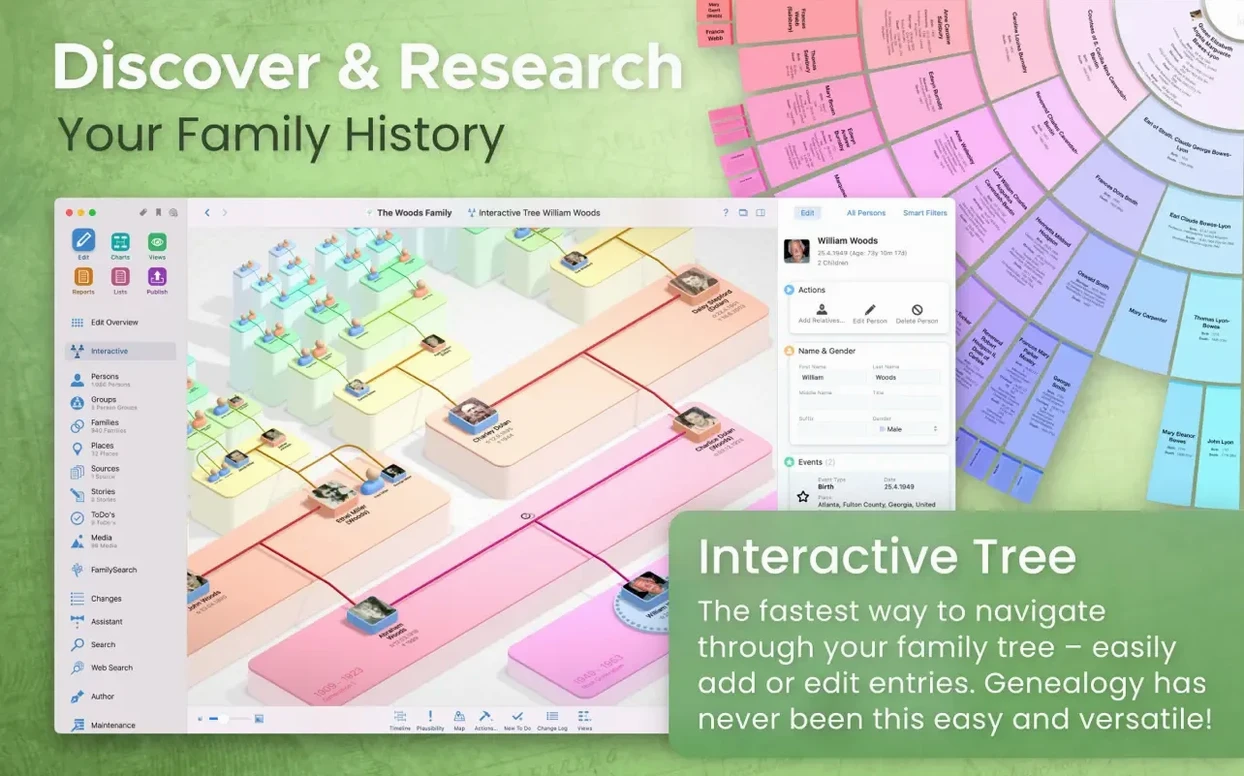
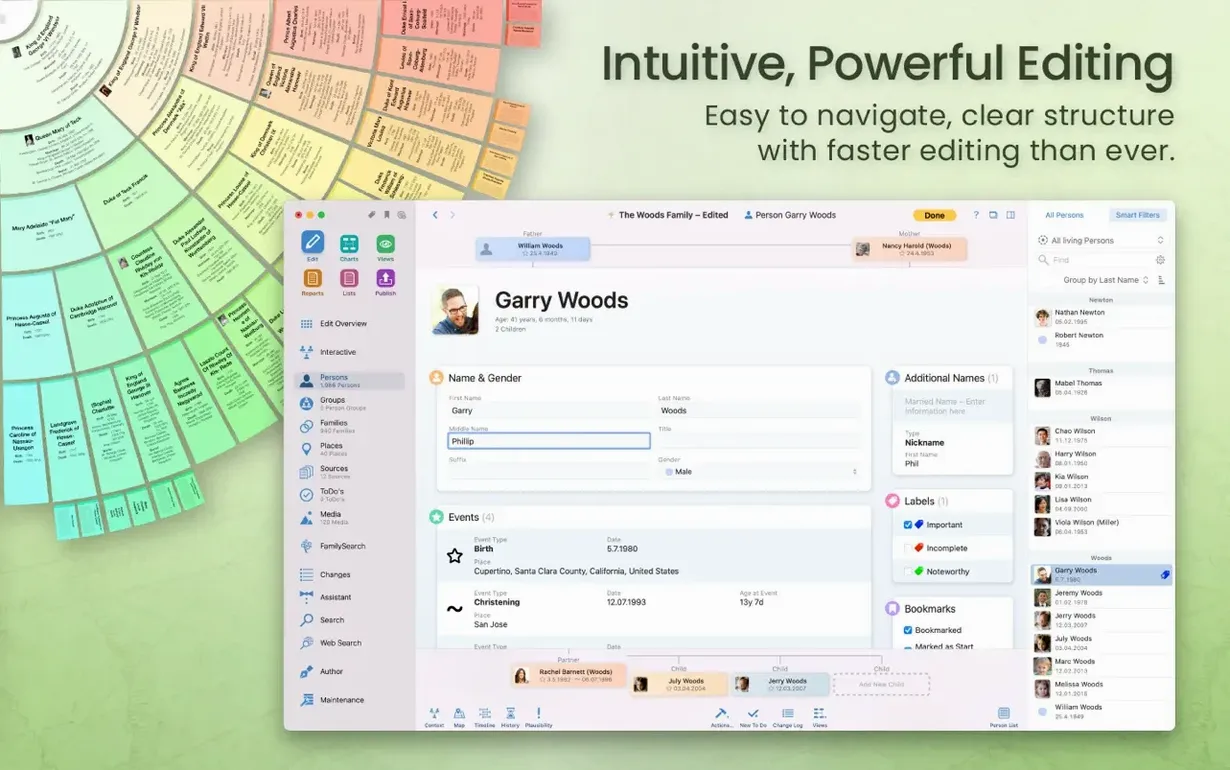
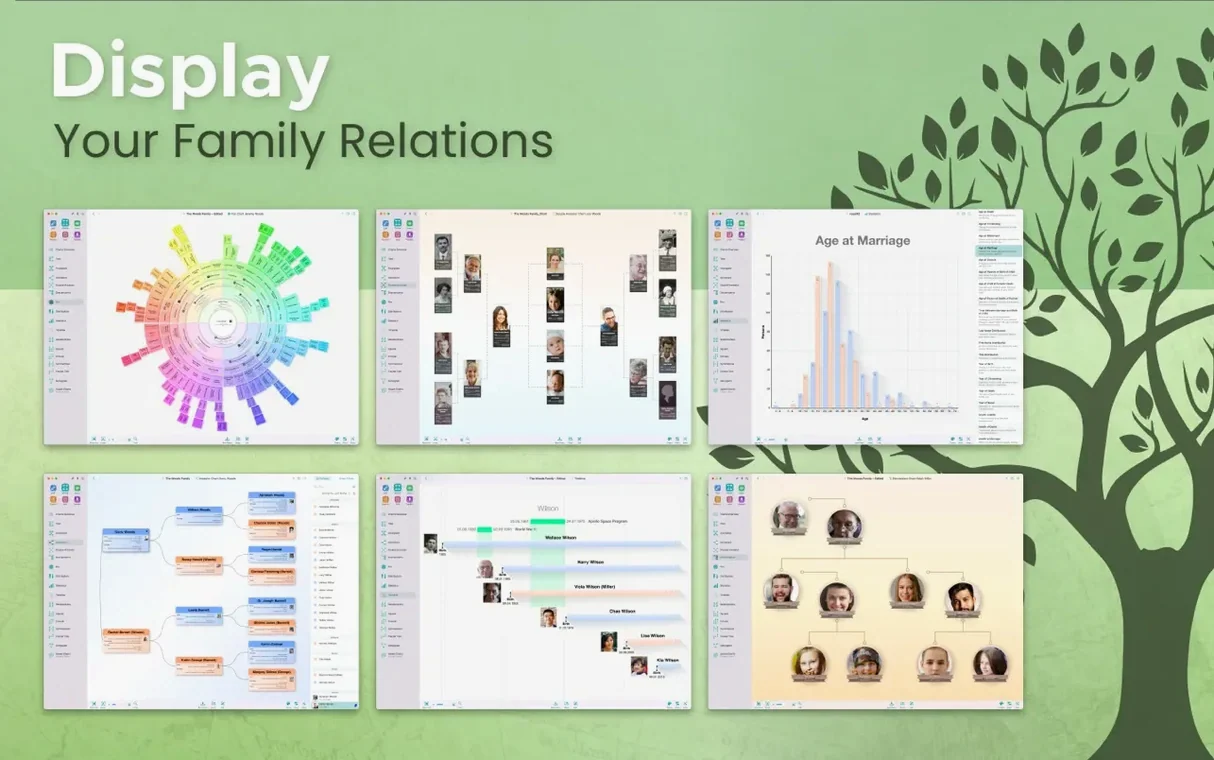
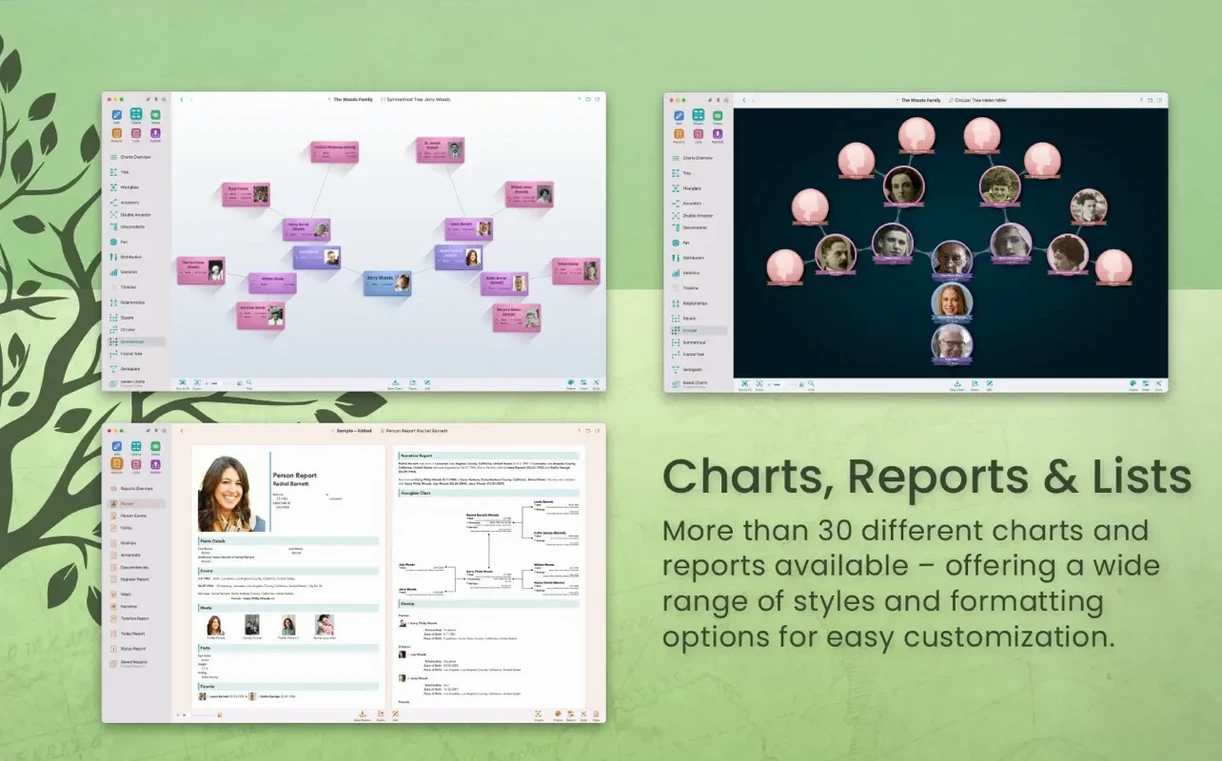
Genealogists, family historians, and anyone curious about where they come from turn to MacFamilyTree for building a detailed, visually rich record of their ancestry. The Mac app gives you an interactive canvas where relatives appear as movable nodes — drag a name and the whole tree reorganizes around it. Behind the scenes, the data lives in a local database or encrypted in iCloud, and the CloudTree Sync & Share engine pushes changes in real time to MobileFamilyTree on an iPhone or iPad.
| What it handles | How it connects |
|---|---|
| Interactive tree, hourglass, pedigree, timeline, fan, genogram, virtual globe, and statistical map charts | iCloud sync between Mac and iOS via CloudTree |
| Reports, books, and direct searches of genealogy portals | Password-protected website export |
| Native Apple Silicon and Intel support on macOS 12+ | Encrypted local storage or iCloud storage |
People searching for “macfamilytree 10 crack” or “macfamilytree 11 torrent” usually want to know what they’re getting into before they install anything. The current version, 11.3.2, is a universal binary — it runs natively on Apple Silicon and Intel Macs, so there’s no Rosetta penalty. The .dmg ships a single application bundle you drag to Applications; there’s no custom installer or kernel extension to worry about. Once it’s running, the chart engine renders large trees without the sluggishness older versions had when you panned across hundreds of names. The iCloud requirement only kicks in when you turn on sync — local-only family files sit quietly in ~/Library/Containers with no network calls.
What’s it like to work in day to day?
Speed rarely becomes a talking point with genealogy software — until you open a tree with 5 000 people and try to redraw the fan chart. MacFamilyTree 11.3.2 handles that on an Apple Silicon Mac without the beachball. The Virtual Globe 3D view, which scatters ancestor pins across a textured sphere, stays responsive even when you spin it with a couple of thousand events mapped. Memory use sits around 400–600 MB for a modest tree of 2 000 individuals; larger databases push that closer to 1.2 GB, which is still comfortable on any Mac with 8 GB of RAM or more.
Stability is uneventful in the best way. CloudTree sync runs on a background queue that doesn’t lock the UI, and the app writes changes to the local SQLite store before pushing them to iCloud — so a dropped connection mid-edit leaves your data intact. The one thing that trips up new users is assuming sync is automatic after installing both MacFamilyTree and MobileFamilyTree. You still need to sign into the same iCloud account on each device and explicitly turn on CloudTree inside the app’s settings pane, then choose which family file to share. Skip that step and you’ll be staring at an empty tree on your iPad wondering where the data went.
No undo button after merging the wrong people
The merge-person dialog is powerful but unforgiving. If you accidentally merge two distinct individuals — say, a grandfather and a great-uncle with similar names — there’s no single “undo merge” button. You have to manually detach relationships, reassign sources, and sometimes rebuild event timelines. A quick backup before merging (File → Back Up Family File) saves hours of cleanup.
Another common slip involves the GEDCOM round-trip. People export a .ged file, edit it in another app, then re-import and are surprised when media links break. MacFamilyTree stores photos and documents inside its own package structure; GEDCOM carries paths and metadata, not the binary blobs. If you’re moving data between apps, plan to relink media on the receiving end.
Beginners also overlook the credibility system. Every fact — birth date, occupation, a census citation — can be marked with a confidence level. Leaving everything at “unverified” makes reports look complete on screen, but the book export will flag inconsistent or unsourced claims. Setting credibility early, event by event, turns the narrative reports from a list of dates into something you’d actually hand to a cousin.
Searches for “macfamilytree 11 crack” or “MacFamilyTree torrent” sometimes come from people who’ve lost a family file because they didn’t realise where the app stores data. A local-only database lives inside the app’s container; if you trash the app without exporting a backup, the tree goes with it. CloudTree users get an extra safety net because iCloud holds a copy, but anyone running purely local should back up regularly to a .mftree file on external storage.
Reunion gives you more control over source citations
MacFamilyTree vs. Reunion. Reunion (Leister Productions) has been on the Mac since the 1990s and attracts researchers who want fine-grained control over source citations and GEDCOM dialects. Its interface feels closer to a database front-end — fields, tabs, precise record numbering. MacFamilyTree trades some of that citation granularity for visual immediacy: the interactive tree and Virtual Globe are presentation tools Reunion doesn’t attempt. If you publish a family website, MacFamilyTree’s built-in export creates a modern, scrollable tree page; Reunion’s web output is functional but plain. Reunion stores its family file as a single .familyfile package that’s easy to move around; MacFamilyTree’s container-based storage is less obvious to locate, though CloudTree compensates if you sync.
MacFamilyTree vs. Heredis. Heredis (BSD Concept) shares a similar ambition — charts, maps, reports — but its Mac version has historically lagged behind the Windows release in update frequency. Heredis puts more emphasis on statistical dashboards and kinship calculators; MacFamilyTree leans harder into the visual tree experience with the 3D globe and fan chart. Both import and export GEDCOM, both sync to mobile companions, but Heredis uses its own sync service rather than iCloud. That means Heredis sync doesn’t count against your iCloud storage quota, but it also means one more account to manage. MacFamilyTree’s iCloud integration is simpler to set up if you’re already deep in Apple’s ecosystem.
MacFamilyTree vs. Gramps. Gramps is open-source, cross-platform, and genuinely deep on data modelling — it supports more event types, more relationship nuances, and more export formats than almost anything else. But its macOS version runs through XQuartz and feels like a Linux app wearing a Mac skin. MacFamilyTree wins on interface polish, speed of navigation, and the sheer pleasure of dragging a tree around with a trackpad. If your priority is rigorous academic genealogy with complex source hierarchies, Gramps may pull ahead. If you want to explore your family history visually and share it without writing CSS by hand, MacFamilyTree is the more natural fit.
Seeing missing ancestors instantly on the fan chart
Visual researchers — people who think better when they can see connections mapped in space — thrive with MacFamilyTree. The fan chart alone, which radiates ancestors outward in colour-coded generations, often reveals gaps (a missing great-great-grandmother) faster than scrolling a list of names. The Virtual Globe appeals to anyone whose family history crosses continents; plotting migration events on a 3D sphere makes patterns tangible in a way a flat timeline cannot.
Families sharing research across devices get the strongest return from the CloudTree sync. A parent can photograph gravestones with an iPhone, attach them in MobileFamilyTree, and by the time they’re back at the desk the images are waiting in MacFamilyTree. The sync model — one family file shared via iCloud — keeps everyone working on the same data without manual merging. That’s a concrete time-saver for multi-generational projects where three relatives are adding branches simultaneously.
Users who want a published website without wrangling HTML will use the MacFamilyTree.com export. The resulting pages are responsive, searchable, and password-protectable; they embed tree navigation, timelines, and media galleries. It’s not a full CMS, but for a family reunion site or a research-sharing page, it covers the essentials with no extra tools. A few people hunting “MacFamilyTree torrent” are actually looking for a way to test that website export before committing to a tree — a local backup and a quiet afternoon with the interactive tree view usually answers the same questions.
- Full compatibility with macOS Sonoma. No more glitchy redraws in the virtual tree view when you rotate around a crowded branch.
- macOS 12 (Monterey) or later
- Apple Silicon or Intel 64-bit Mac
Comments 0
Sign in or create an account to leave a comment.
No comments yet. A codec, a slice, a machine — they appear after moderation.