Farrago for macOS
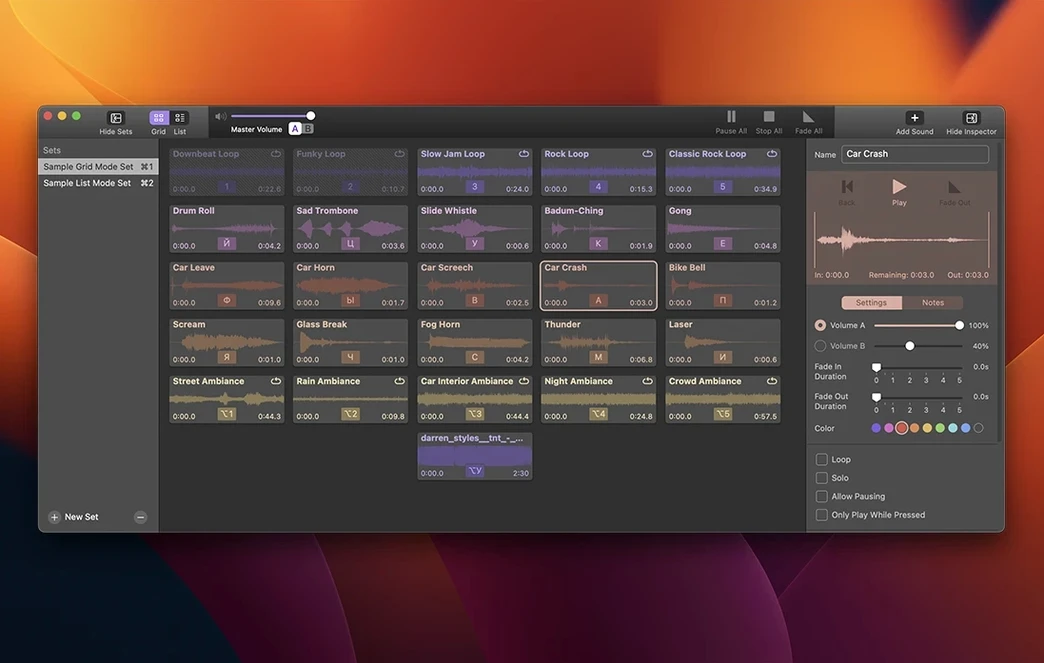
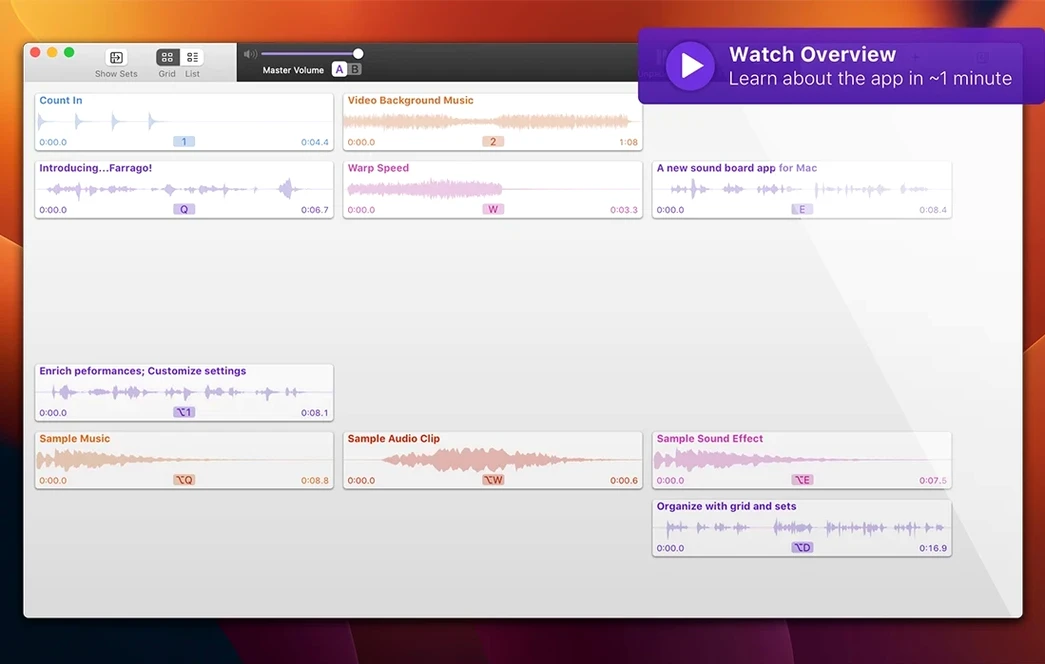
Farrago is a Mac soundboard for firing off audio clips the moment you need them. Here's how a single, realistic task works from beginning to end.
| Detail | Info |
|---|---|
| Developer | Rogue Amoeba Software |
| Current version | 2.2.0 |
| macOS requirement | macOS 14 Sonoma |
| Architecture | Apple silicon and Intel |
Suppose I'm running a live tabletop game session and I need a cavern ambience clip that doesn't overstay its welcome. I drop the long field-recording file onto a tile in Farrago's grid. The editor lets me scrub the waveform and set precise in and out points, so only the 90-second section I care about stays playable. I assign a global hotkey — ⌃⌥⌘C — and check “Restart playback when triggered” so the clip always begins at my trim point. I route just that tile's output to a specific virtual device I set up in Loopback, keeping the ambience separate from my voice chat app. With the dark theme on, the grid stays readable in a dim room. When the party enters a new zone, I switch to a different tile in the list view, which queues the next mood-setting track for sequential playback. Each sound I add gets copied into Farrago's internal library, so the original files can be moved without breaking the board. If I later want to capture the whole mix, a connection to Audio Hijack records every triggered sound along with my microphone input.
Is it a standalone app or does it need other Rogue Amoeba tools?
Farrago works perfectly on its own. If you’ve found a farrago download and installed it, you get a fully capable soundboard — importing files, building tile grids, assigning hotkeys and triggering via MIDI all work without installing anything else. The integrations with Loopback and Audio Hijack are optional conveniences, not dependencies. Loopback helps when you need per-tile routing to different apps, and Audio Hijack is useful for recording triggered sounds alongside a microphone, but neither is required for basic playback. If you’re using farrago for mac purely to fire sound effects into a single output during a live stream, you can ignore the routing extras entirely.
Why you can delete the original file after import
Farrago copies every file you import into its own internal library — a folder inside ~/Library/Application Support/Farrago/. The copy is what the app references during playback. That means you can delete, rename or move the original source file without breaking any tile. If you’re working with a Farrago torrent Mac build, know that the library folder is where your working files live, so backing up that path preserves every tile’s content. The trade-off is disk space: a large set with long clips will duplicate whatever you feed it, but for most users that’s a small price for a board that never breaks its links.
Trigger a sound when a Focus mode activates
Version 2.2.0 improved Shortcuts support, so you can trigger tiles from Shortcuts automations without touching the app directly. You can build a shortcut that fires a specific sound when a Focus mode activates, or chain a tile trigger after a timer ends. The Shortcut actions talk to the currently open set, and you pick the tile by its name inside the shortcut editor — no scripting needed. This is especially useful for theater technicians who want to link sound cues to a scripted sequence of actions triggered from a single button press on stage.
Reorder your cue list without opening the editor
- Drag to reorder in list view. The list view isn't just for display — you can drag rows to reorder the playback queue on the fly, which is faster than opening the editor for last-minute cue changes.
- Copy tile settings. Right-click a tile and choose “Copy Tile” to duplicate not just the audio but the name, color, trim points and fade settings. Useful when building variations of the same cue.
- MIDI note learning. In the MIDI preferences pane, clicking a tile and pressing a pad on your controller assigns it immediately — no dropdown menus or manual note-number entry.
- Per-tile volume persistence. Each tile remembers its own output level independently. If one effect always plays too hot, pull its slider down once and it stays there across sessions.
- Hide unused tiles. You can reduce visual clutter by right-clicking any tile and selecting “Hide,” which keeps the sound loaded and hotkey-triggerable but removes it from the grid.
- Runs on macOS 27 (Golden Gate).
- Shortcuts support has been strengthened for more automation control.
- Several editor improvements make trimming and waveform navigation smoother.
- macOS 14 Sonoma or later
- Apple silicon or Intel Mac
$ man farrago | grep -A2 "?"
Can Farrago route individual tiles to different outputs?
Yes. Each tile has its own output routing control, and Farrago integrates with Loopback to send audio to separate virtual devices.
Does Farrago keep the original audio files or just link to them?
It copies every sound you add into its own internal storage, so moving or deleting the original file won't break your soundboard.
Comments 0
Sign in or create an account to leave a comment.
No comments yet. A codec, a slice, a machine — they appear after moderation.