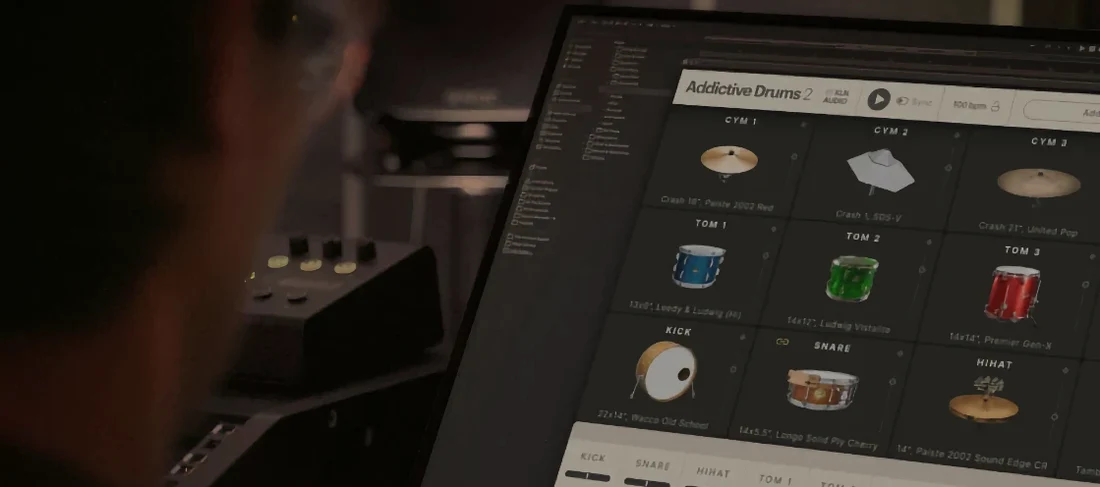
Addictive Drums 2 for macOS
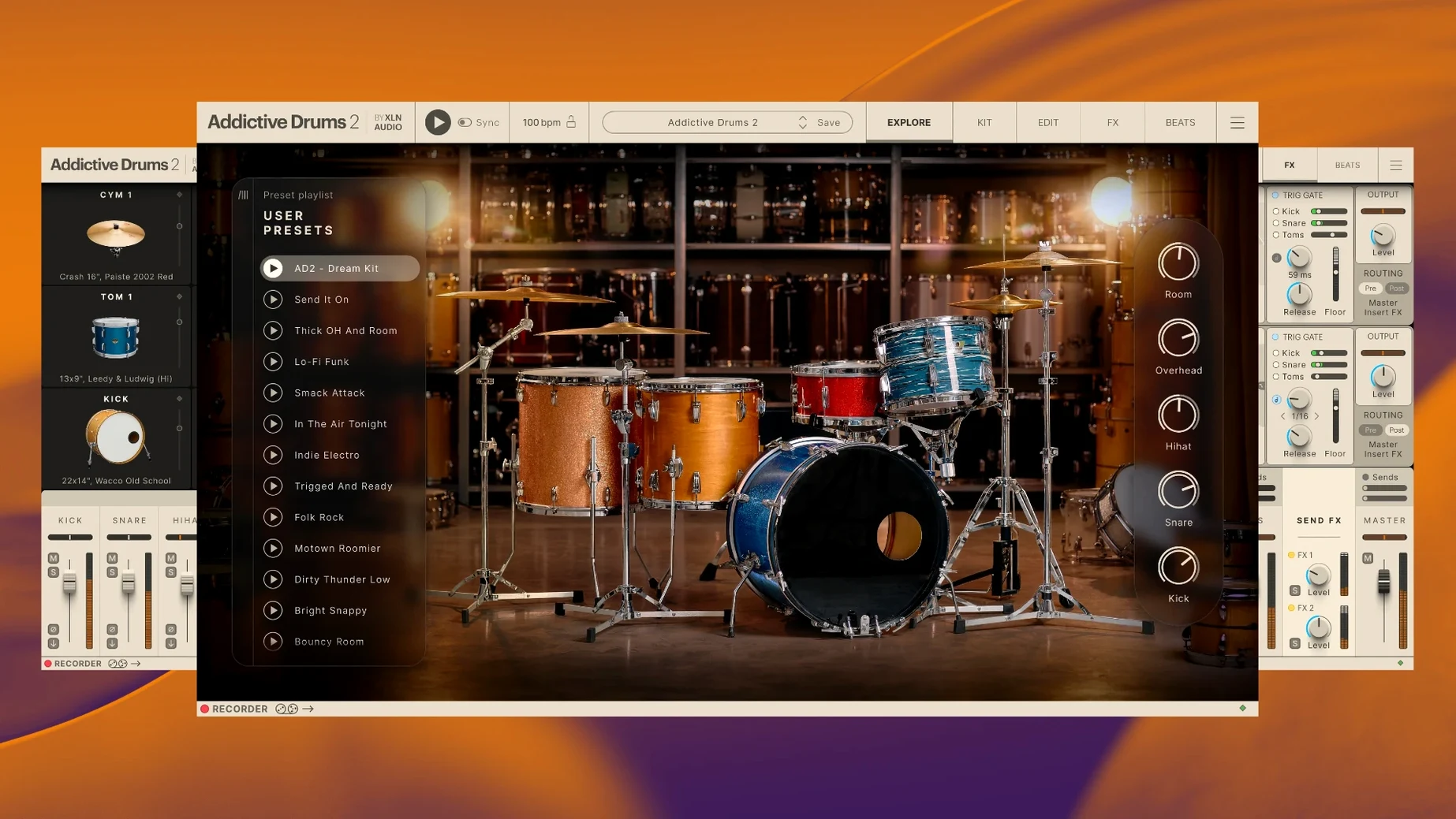
You have a riff, a bassline, maybe a synth pad, but the rhythmic skeleton is still a click track. Programming realistic drums from one-shot samples can feel like assembling a skeleton bone-by-bone without knowing the anatomy. Addictive Drums 2 tackles this by combining a dedicated drum engine with curated kits, mix-ready presets, and MIDI grooves, so you build a performance rather than just a pattern.
Grab a ready-made drum mix without extra routing?
- Songwriters who want a produced drum sound without deep multi-out mixing right away.
- Producers building tracks across genres, since expansion ADpaks cover kits from jazz brushes to metal.
- Running natively on both Intel and Apple Silicon Macs under a single 64-bit binary.
Is the base library just a starting point?
- The core library is a taste; the full palette lives in separate ADpaks, MIDIpaks, and Kitpiece Paks that form the Complete Collection.
- Its interface stays in English, even if your DAW speaks another language.
- Requires macOS 10.13 or later—older studio machines stuck on 10.12 won't load it.
First days with Addictive Drums 2
Fresh install, you open the standalone or load the plugin in your DAW, and the default kit loads with a preset already dialed in. Resist the urge to browse ADpaks immediately. Instead, spend twenty minutes on two things that pay off later.
Map your controller. If you play an e-kit or a pad controller, open the Map Window (the little gear near the kit piece names) and check that your hi-hat pedal sends continuous control data the engine can read. The hi-hat articulation engine distinguishes open, closed, and in-between states from CC messages, not just note numbers. A poorly mapped pedal gives you two hi-hat sounds—fully open or fully closed—and misses all the foot-splash and half-open shades that make programmed drums breathe. Set your pedal to send CC4 and verify the on-screen pedal icon tracks your foot smoothly.
Learn the kit piece mixer. Click any drum and the right panel shows its individual channel strip: overhead and room sends, envelope, pitch, and often a sample layer selector. You can swap a snare top head for a rimshot or a sidestick, or blend between two samples with the layer fader. Most kits ship with multiple snare and kick options tucked behind those dropdowns—the default choices are just the starting point.
Quick-fix checklist for common snags
Three problems surface often enough to warrant a cheat sheet.
DAW sees the plugin, but no sound on playback. Addictive Drums 2 routes its audio to the instrument track you inserted it on, but some DAWs default to a stereo input expecting a mono source. Check that your track's input monitoring is set to Auto or On. If you use multi-out routing (16 stereo outputs available), confirm your aux tracks are armed and assigned to the correct plugin outputs. The standalone app has its own audio device selector under Preferences—if it works there but not in the DAW, the problem is the DAW's routing, not the plugin.
Split archive won't extract. The Complete Collection download arrives as a .zip.001, .zip.002, and so on. Every part must sit in the same folder, with identical filenames except for the numeric suffix. Right-click .zip.001, choose Open With, and pick an archive utility that understands split archives—Keka handles this cleanly. The built-in macOS Archive Utility often stumbles on multipart files and produces an incomplete result or nothing at all.
Cymbal choking feels wrong. If you play an e-kit and grabbing the crash edge doesn't silence the cymbal, you likely need to configure aftertouch or a dedicated choke note in the Map Window. Some pads send polyphonic aftertouch; others use a separate MIDI note for the choke. The engine supports both, but you have to tell it which method your hardware uses.
A singer-songwriter's afternoon with the Fairfax kit
Imagine someone cutting a demo in a home-treated bedroom: acoustic guitar, vocals, bass DI, and no real drums. The song calls for a dry, tight kit that sits behind a fingerpicked verse and opens into a full-band chorus. No jazz brushes, no arena tom fills—just pocket.
They open the Fairfax ADpak, which models a vintage Gretsch kit with controlled resonance and less low-end bloom than the Black Velvet or United Pop kits. The Indie Dry preset from the Fairfax menu gets them 80% there: close mics prominent, room mics pulled back, a hint of compression on the snare. The verse needs a cross-stick, so they open the snare detail panel and switch the articulation from center hit to sidestick. For the chorus, they duplicate the MIDI clip and swap the snare back to a full hit with a slightly higher velocity curve on the kick.
They add a MIDI groove from the Indie MIDIpak—an eighth-note hi-hat pattern with ghost notes—then tweak the kick pattern to match their bassline's rhythmic accents. The built-in Beat Transformer lets them nudge the hi-hat timing a few ticks ahead for a rushed, human feel on the chorus, while keeping the verse locked to the grid. A small send to the room bus adds just enough space that the drums don't sound like they were tracked in a vocal booth. Total time from empty project to printed drum stems: about forty minutes.
Walkthrough: building a modern pop chorus from scratch
This is a task where the Complete Collection's breadth actually changes your workflow. You are not stuck tweaking one kit into a shape it wasn't designed for.
- Pick the foundation. Load the United Pop ADpak. Its Yamaha kit has the punchy, pre-EQ'd sound that fits layered pop production. Recall the Radio Ready preset, which already has compression, gating, and reverb dialed in for a forward mix position.
- Swap the kick. Open the kick's sample layer panel. United Pop ships with three kick options: try the Subby sample for more low-end sustain. Blend the direct mic at 70% and the sub channel at 30% for weight without losing definition on small speakers.
- Add a percussion element. Load a second instance of Addictive Drums 2 on a new instrument track. Choose the Session Percussion ADpak and call up a tambourine kit piece. Program a steady eighth-note tambourine pattern panned slightly left to weave through the hi-hats.
- Trigger a MIDI groove. Browse the Modern Pop MIDIpak for a chorus-appropriate groove—look for open hi-hat accents on the "and" of beat four. Drag the MIDI file onto your United Pop track. The groove plays the kit's natural mapping, but you can adjust individual drum hits in the piano roll afterward.
- Shape the room. On the United Pop mixer, raise the Room fader to taste and dial the room mic's high-pass filter to 200 Hz so the reverb tail doesn't muddy the low end. For the percussion instance, kill the room send entirely—tambourine reverb in a dense pop chorus creates more wash than space.
- Print or freeze. Route both instances to a drum bus in your DAW, add a gentle bus compressor (2:1 ratio, slow attack), and freeze the tracks if your session is getting heavy. Two AD2 instances running multi-out with convolution room mics can tax an older Intel Mac; freezing frees up cycles for your vocal chain.
If you have been digging around for addictive drums 2 presets free download or an addictive drum 2 torrent, keep in mind that the preset and MIDI ecosystem is where much of the personality lives—third-party user presets float around forums and can be dropped into your user preset folder, but the expansion ADpaks themselves are the real palette. The Complete Collection bundles them from the start, so you are not left hunting down individual addictive drums 2 vst free download links for each kit you want to try.
Why do M-series Macs handle more instances now?
Version 2.9.1 runs as a universal binary, so Apple Silicon Macs load it natively without the Rosetta 2 translation layer. For users on M-series machines, this matters most when you run multiple instances: native code means lower per-instance CPU overhead, which translates directly to more simultaneous ADpaks in a session before you hit a buffer underrun.
The audio engine has stayed fairly consistent throughout the 2.x cycle—the core sound-shaping tools (envelopes, pitch, sample layers, the effects rack) haven't been overhauled, and older session files open predictably. What has improved is the plugin's stability as a VST3 and Audio Unit on recent macOS versions. Early 2.x builds occasionally dropped their authorization state after a macOS point update; the current build handles the system's code-signing checks more gracefully. If you are coming from an older addictive drums 2 mac os installation, the upgrade path is straightforward: the installer replaces the plugin binaries and leaves your user presets and kit piece tweaks untouched in ~/Documents/XLN Audio/.
- macOS 10.13 or later
- 64-bit Intel or Apple Silicon processor
- Audio Unit, VST3, or AAX plugin host
$ man addictive-drums-2 | grep -A2 "?"
What expansion types exist for Addictive Drums 2?
XLN Audio offers three kinds: ADpaks for drum kits and presets, MIDIpaks for beats and grooves, and Kitpiece Paks for individual drum pieces.
Comments 0
Sign in or create an account to leave a comment.
No comments yet. A codec, a slice, a machine — they appear after moderation.
More in VST Plugins
cd ../ Addictive Keys
VST Plugins 4.2 GB
 Ample Guitar M
VST Plugins 5.2 GB
 Ample Sound Ample Guitar LP III
VST Plugins 9.2 GB
 Analog Realism Sphinx 101
VST Plugins 82 MB
 Arturia Analog Lab V
VST Plugins 2 GB Updated
 Arturia Augmented BRASS
VST Plugins 2.3 GB
 Arturia Efx AMBIENT
VST Plugins 285 MB
 Arturia Emulator II V
VST Plugins 700 MB