
Ample Sound Ample Guitar LP III for macOS
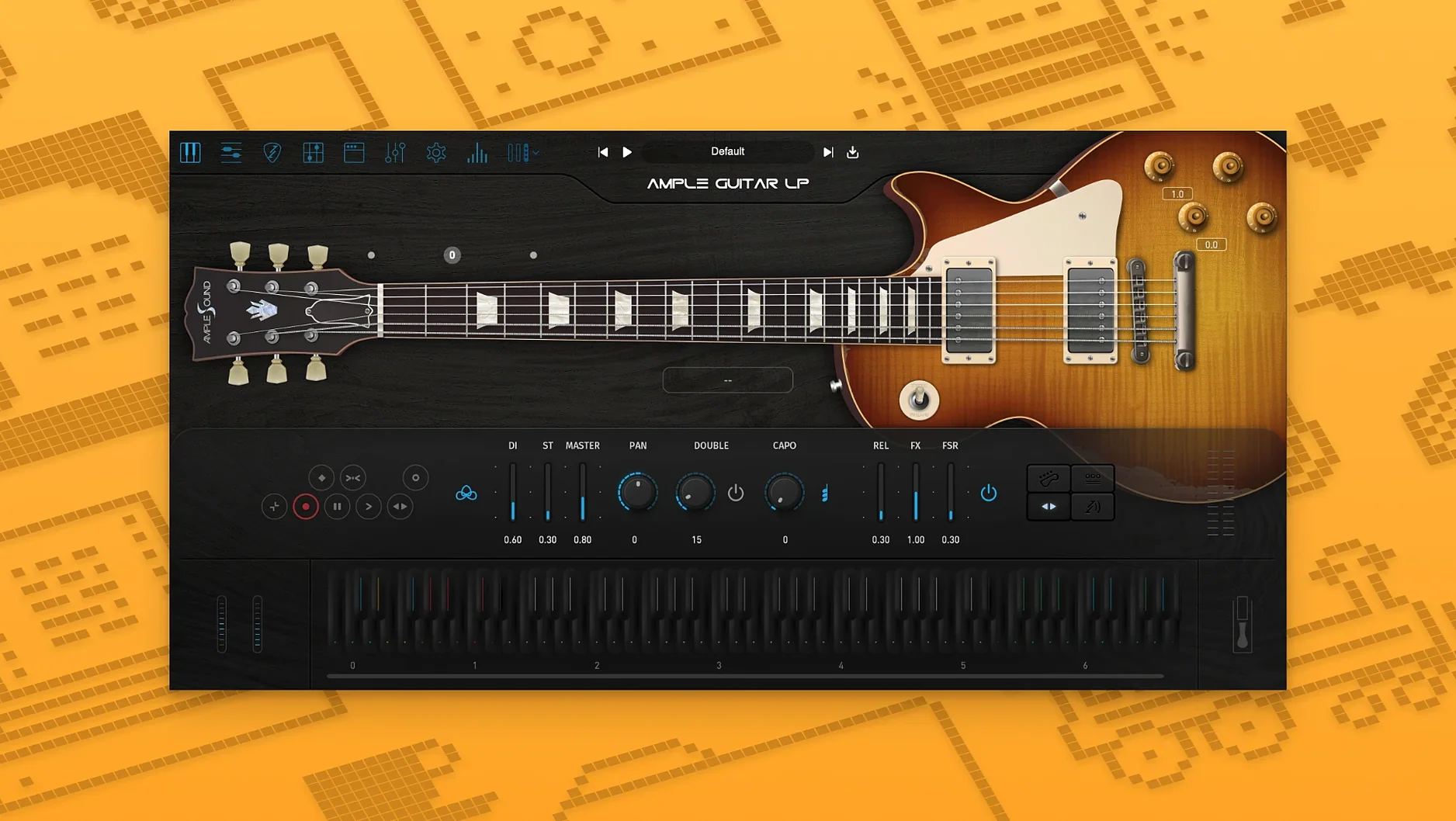
Ample Guitar LP III is a virtual instrument plugin built around the sound of a Gibson Les Paul 1958, now with a v4 fingerstyle library sourced from a '59 Reissue. It’s a studio tool for producers who need convincing electric guitar parts without mic'ing a cab.
Installs as VST3 and AU for Apple Silicon Macs
The plugin ships as .dmg and installs VST3 and AU components, running native on Apple Silicon and Intel Macs under macOS 10.13 or later. Load it in Logic Pro, Ableton Live, Cubase, or any compatible DAW.
What’s the sound engine like?
You get fingerstyle, picking, and string-effect articulations running through a built-in amplifier and onboard effects. The raw samples capture the sustain and bite of a PAF-equipped Les Paul; the DSP chain lets you shape the tone without leaving the plugin window.
How does the fingerstyle library work?
Version 4 added a dedicated fingerstyle sample set recorded with a 1959 Reissue, giving you a rounder attack for ballads and R&B parts alongside the standard picked articulations.
Keyboardists writing unplayable guitar lines connect fastest
Keyboard players writing guitar lines they can't physically play get the most immediate value. The fingerstyle library added in version 4 makes it particularly useful for songwriters building ballads or R&B demos where a picked Strat sound feels too bright. You program the part, pick an articulation, and the engine handles the string transitions.
Studio composers who need to drop a convincing blues or classic rock rhythm part into a track without booking a session guitarist will also find it earns its keep. The Les Paul 1958 voicing sits in a mix differently from super-strat libraries — it's thicker in the low mids, which means less EQ wrestling when the arrangement already has synths or strings occupying the upper register.
Guitarists who treat it as a writing scratchpad benefit too. Late-night ideas captured on a MIDI controller at low volume, then later re-tracked with a real amplifier, often start here. The onboard amp is good enough that the scratch take sometimes survives into the final mix.
Why the fingerstyle library softens the transient
Runs offline after a one-time activation handshake
Yes, once activated. Ample Sound uses an Activation Manager that handles the initial handshake; after that the plugin runs offline. If you're on a studio machine that never touches the network, offline activation via Challenge Code and User ID is available right in the installer flow.
Will it choke a modest Mac?
The sample engine streams from disk rather than loading everything into RAM, so memory pressure stays reasonable. On an M1 or M2 machine the fan rarely spins up even with multiple instances. On older Intel hardware from the 2015–2017 era, sticking to one or two instances and freezing tracks when you're happy with the take keeps things smooth.
How long do I actually have to try it?
Ample Sound offers a 7-day fully functional demo period, which is enough to run it through a real session and hear how the Les Paul body resonance behaves under compression. No feature locks, no muted notes every few bars — what you hear in the trial is what ships.
Force phrases onto the wound third string via keyswitch
- String selection by keyswitch. You can force a phrase onto the wound third string for a darker timbre, or push high notes onto the plain strings where they cut through. The keyswitches are mapped at the low end of the MIDI range and labeled in the interface.
- Slide velocity threshold. Play a legato interval softly and the engine triggers a hammer-on or pull-off; hit it harder and it slides. The threshold is adjustable, so you can tune it to match your controller's keybed response.
- Double-track trick without duplicating the track. The built-in doubler in the effects section applies a short stereo delay with subtle pitch modulation. Dial it in around 20–30 ms per side and the part fattens up without sounding like a chorus pedal.
- MIDI drag from the tab player. The internal riff tab player lets you drag its MIDI straight into your DAW timeline. Useful for grabbing a strumming pattern you like and then editing the voicings yourself.
A 1959 Reissue now captures rounded thumb attacks
Version 4's headline addition — the fingerstyle library recorded with a 1959 Reissue — means you no longer need to fake soft attacks with velocity curves. Pluck articulation on the wound strings now has the rounded transient of a thumb stroke, which matters for genres where a pick attack feels too aggressive.
Loading times improved noticeably with the 4.x streamer rewrite. On an external SSD over USB-C, a full articulation set loads in a few seconds rather than the half-minute wait earlier versions could hit. For composers working to picture who need to audition five guitar tones in quick succession, that change alone tightens up the workflow.
The amp section saw a gain-staging revision sometime around the 4.0.1 point release. Pushing the drive control past noon now breaks up more gradually, making it easier to land on that edge-of-breakup tone without the jump from clean to full saturation that earlier builds sometimes produced.
- macOS 10.13 or later
- Apple Silicon or Intel processor
- VST3 or AU-compatible DAW
$ man ample-sound-ample-guitar-lp-iii | grep -A2 "?"
Can I use this without an audio interface?
Yes, you can program parts with MIDI and hear playback through the built-in amp and effects, though an interface helps with monitoring latency during live tracking.
What kind of music is it suited for?
The Les Paul 1958 character fits rock, blues, pop, and R&B — anywhere a thick humbucker tone and articulate picking or fingerstyle parts are needed for studio production.
Comments 0
Sign in or create an account to leave a comment.
No comments yet. A codec, a slice, a machine — they appear after moderation.
More in VST Plugins
cd ../ Ample Guitar M
VST Plugins 5.2 GB
 Analog Realism Sphinx 101
VST Plugins 82 MB
 Arturia Analog Lab V
VST Plugins 2 GB Updated
 Arturia Augmented BRASS
VST Plugins 2.3 GB
 Arturia Efx AMBIENT
VST Plugins 285 MB
 Arturia Emulator II V
VST Plugins 700 MB
 Arturia FX Collection
VST Plugins 16.1 GB
 Arturia Mellotron V
VST Plugins 2.1 GB