
Analog Realism Sphinx 101 for macOS
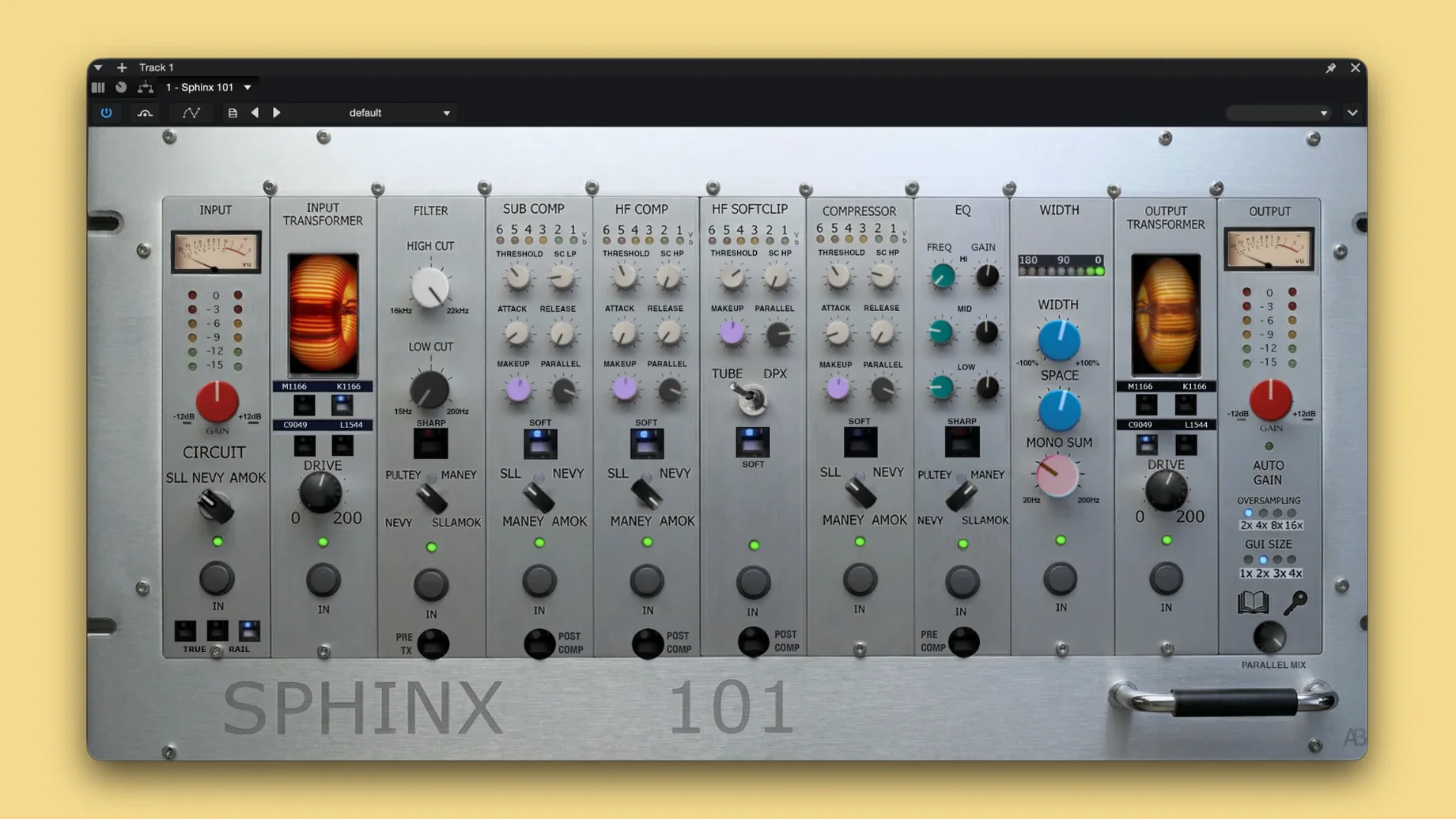
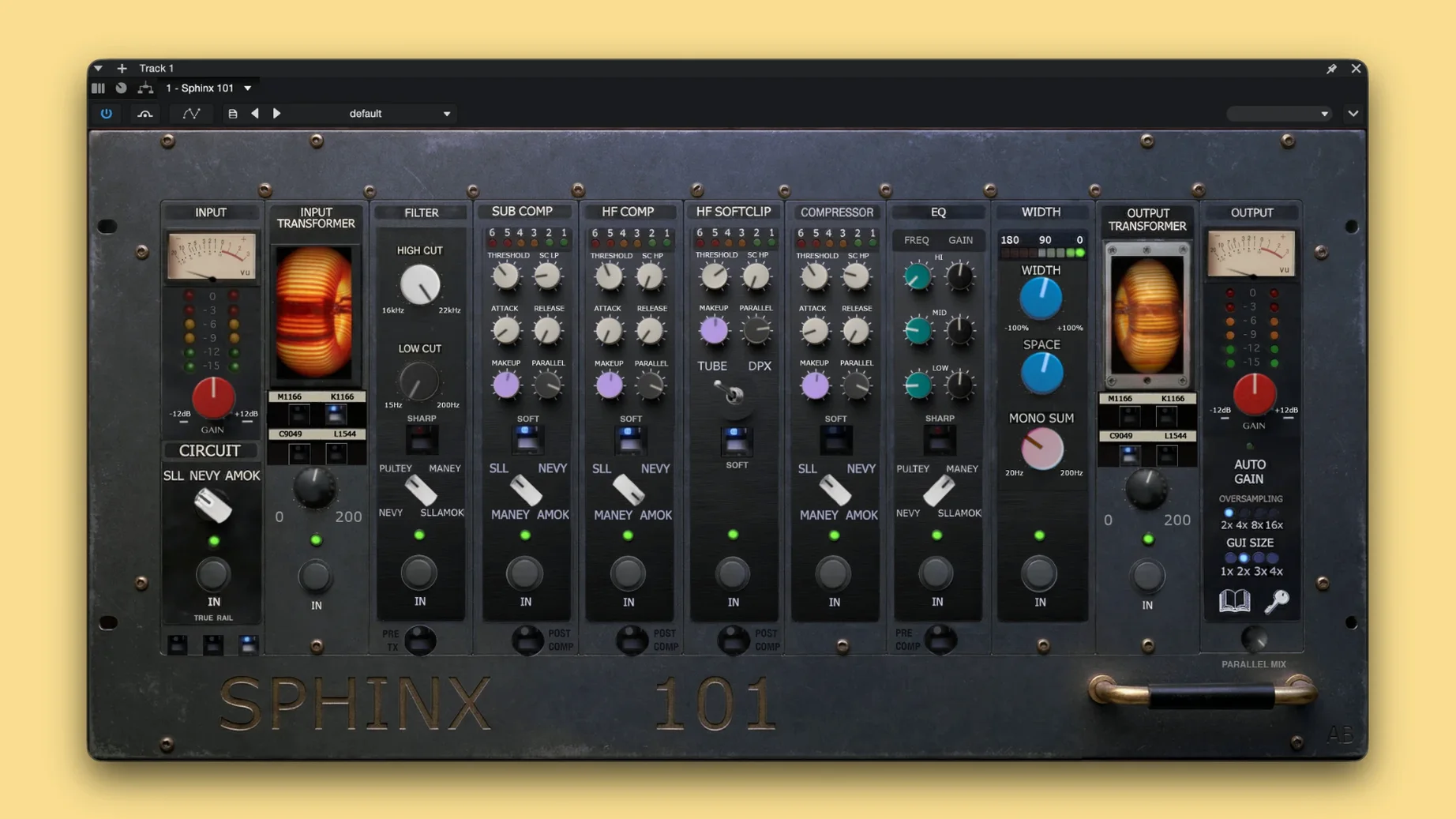
Twelve analog modeling mechanisms run inside one .component or .vst3 bundle. Sphinx 101 sits on the master bus — that is its defined role — but it works just as naturally across drum and instrument groups where the same circuit colors make sense. It models five hardware topologies under their stylized names: Pultey, Nevy, SLL, Amok, and Maney, each bringing a distinct EQ curve, filter slope, or dynamic grab to the chain.
| Detail | Value |
|---|---|
| Version | 1.3.2 Rev 1 |
| Formats | AU, VST3 |
| macOS | 11 and later |
| Architecture | Apple silicon + Intel native |
On a stereo bus, the interaction between the modeled gain stages and the program-dependent time constants is the thing you notice first — push into a Nevy-style transformer and the low-end folds in a way a clean digital limiter will not reproduce. The Pultey-style EQ section gives you the broad, overlapping curves that make a two-knob boost sound like more than the sum of the bands, while the SLL-style compressor grabs transients with that unmistakable glue. Because all twelve mechanisms interact rather than stack as isolated blocks, small moves on one module shift how the next one reacts, which is exactly why it earns its master bus label — a dozen small nonlinearities summing into a finished sound.
Why start with a mix you already know intimately?
Drop it on a mix you already know well, one where you recall exactly how the low end behaved on other systems. Pull up the Nevy circuit first and leave the threshold where it barely tickles the loudest snare hit — that is where the transformer model starts to round transients without obvious compression. Spend fifteen minutes just sweeping the Pultey-style high band while the Amok dynamics section is bypassed, so you learn how the overlapping curves interact before adding the nonlinearities back in.
Save three user presets early: one with the SLL circuit at a gentle 2:1 ratio and no EQ, one with the Maney filter section high-passing at 40 Hz into the Amok limiter, and one blank slate with all modules reset. Having those starting points prevents the "twelve knobs deep and lost" feeling that hits around day two. Also, open the ~/Library/Audio/Plug-Ins/VST3/ folder and confirm the bundle size matches what the installer reported — a corrupt copy will still validate in some hosts but produce intermittent glitches under heavy TrueRail load.
What’s the licensing setup before you install?
Does one installer cover both Apple silicon and Intel?
Yes. The single installer places universal binaries for both AU and VST3, so Logic Pro and Reaper load the arm64 slice without Rosetta, while older Intel machines get the x86_64 code path from the same .component bundle. You do not need separate downloads or manual architecture selection.
Will it choke on a dense mix?
The 79 automation-compatible parameters report their state per sample block, but the real processing happens across 34 interacting analog mechanisms — that math is constant regardless of how many tracks feed the bus. On an M1 or later, expect roughly the same CPU draw at 44.1 kHz as at 96 kHz because the TrueRail oversampling runs at a fixed internal rate. Older Intel Macs will show a moderate hit; just avoid running three instances on a 2015 MacBook Air.
Activation looks unusual — is that normal?
The included activation instructions reference a GUISEPPE keyed release. Follow those steps exactly, particularly the part about disabling network checks during the initial scan, and your host will pick up Sphinx 101 without further challenge. The plugin does not phone home afterward.
What do you lose by skipping the EQ and filter sections?
Against Klanghelm MJUC, Sphinx 101 trades variable tube topologies for fixed circuit emulations. MJUC gives you three distinct compressor models with a simpler control set and a lighter CPU footprint, but it lacks the EQ and filter sections that make Sphinx a true bus processor rather than just a dynamics tool. If your work stops at gentle leveling, MJUC is quicker; if you need one plugin that shapes tone, stereo width, and transient behavior under a single TrueRail hood, Sphinx 101 covers more ground.
Next to IK Multimedia T-RackS 5 Bus Compressor, the difference is modularity. T-RackS treats the bus compressor as one piece of a larger chain you build from separate modules. Sphinx 101 keeps all circuits in one window with the analog modeling mechanisms feeding into each other continuously — changing the Pultey EQ curve alters what the Amok limiter sees, which is closer to how a physical console strip behaves. T-RackS offers more total modules and a broader plugin ecosystem, but the component-accurate modeling in Sphinx sounds more coherent when you push multiple stages at once.
The Brainworx bx_townhouse Buss Compressor focuses entirely on the SSL-style bus compressor and does it with spot-on modeling of one specific console. Sphinx 101 does not pretend to be a single console — the SLL, Nevy, and Amok circuits cover three distinct compression signatures, and the Pultey and Maney sections add EQ and filtering that the bx_townhouse leaves to other plugins. If you're setting up an Analog Realism Sphinx 101 Mac torrent and want one console flavor done perfectly, bx_townhouse is that flavor. If you want to switch between transformer, VCA, and opto-style bus processing without opening three different plugins, Sphinx 101 keeps it in one window.
- macOS 11 or later
- Apple silicon or Intel processor
- AU or VST3 host
$ man analog-realism-sphinx-101 | grep -A2 "?"
What plug-in formats does Sphinx 101 use on macOS?
It ships as an Audio Unit (.component) and a VST3 (.vst3), both universal binaries for Apple silicon and Intel Macs running macOS 11 or later.
Which hardware circuits does it model?
The processor models five circuit families named Pultey, Nevy, SLL, Amok, and Maney, covering EQ, filter, and dynamic sections inside a single plug-in.
Is it only for the master bus?
It is presented as a master bus processor, but the modeled circuits work on drum buses, instrument groups, and anywhere you want interacting analog-style color and dynamics.
Comments 0
Sign in or create an account to leave a comment.
No comments yet. A codec, a slice, a machine — they appear after moderation.
More in VST Plugins
cd ../ Ample Sound Ample Guitar LP III
VST Plugins 9.2 GB
 Ample Guitar M
VST Plugins 5.2 GB
 Arturia Analog Lab V
VST Plugins 2 GB Updated
 Arturia Augmented BRASS
VST Plugins 2.3 GB
 Arturia Efx AMBIENT
VST Plugins 285 MB
 Arturia Emulator II V
VST Plugins 700 MB
 Arturia FX Collection
VST Plugins 16.1 GB
 Arturia Mellotron V
VST Plugins 2.1 GB