Arturia MiniFreak V for macOS
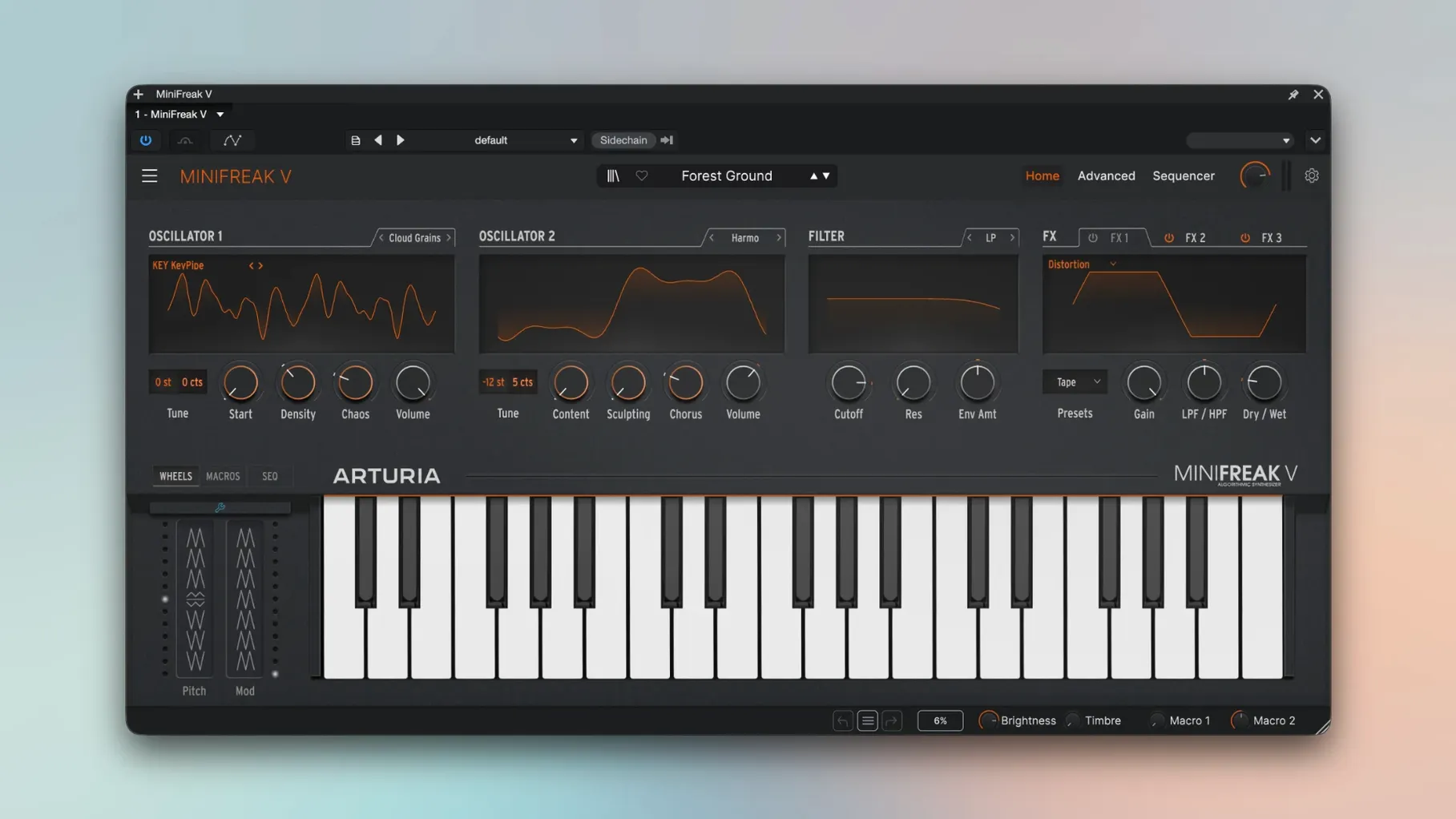
If you've used the MiniFreak hardware, MiniFreak V is the same architecture living inside your DAW as a plugin.
Track role — where MiniFreak V sits in a session. It works as a polyphonic hybrid synthesizer on instrument tracks, handling leads, pads, basses and experimental textures. Its dual digital sound engines let one instance cover jobs that would otherwise need two different synths, splitting duties between tonal and noise-based sources.
Bus role — how it behaves on auxiliary channels. The 3 FX slots with 13 choices mean you can route a dry signal through MiniFreak V purely for its processing chain, using it as a flavor bus for saturation, modulation and spatial effects.
Modulation — the routing matrix and spontaneous modulation are where the experimental character comes from. Assigning sources to destinations inside the matrix turns static patches into moving ones without drawing automation.
Seq & Arp — built-in sequencing and arpeggiation make it a self-contained pattern generator. On a track, it can drive rhythmic ideas without external MIDI clips.
Preset portability — patches made on the hardware open here, and vice versa. That means a session can start with a preset shaped on the physical MiniFreak and continue in the plugin, or the other way around.
User samples and wavetables now load into the oscillators
The update that landed with 5.0.0.6875 centers on two additions that change how you build patches day to day: user sample import and wavetable import. Before this version, MiniFreak V worked strictly with its internal oscillator models — now you can drop your own audio files and wavetables directly into the digital engines.
Here’s what that practically means in a session:
- User sample import — drag a short sample onto an oscillator slot and MiniFreak V treats it as a sound source. The engine maps it across the keyboard, and the analog-modeled filters and modulation matrix apply to it like any other voice. Found sound textures, vocal chops or drum hits become polyphonic playable tones without bouncing to a sampler track first.
- Wavetable import — load custom wavetables into the wavetable engine. If you’ve built wavetables in Serum, Vital or a dedicated editor, those files now live inside MiniFreak V’s modulation and filter structure. The import reads standard wavetable formats, so a library built for another synth ports over with minimal friction.
Neither feature existed in the hardware at launch, so this version pulls the plugin slightly ahead of its physical counterpart for patch design flexibility. The workflow stays the same — everything still flows through the same dual-engine path into the analog-modeled filters — but the raw material you start with is no longer fixed.
Where MiniFreak V overlaps with Pigments, MicroFreak, and Serum
MiniFreak V doesn’t sit neatly in one category, so comparisons depend on what you’re asking the synth to do. Here’s how it lines up against three others that overlap in different ways.
Arturia Pigments — Pigments offers deeper wavetable and sample engines, more modulation sources and a more detailed UI for sound design. MiniFreak V counters with a faster, more constrained workflow: fewer parameters, a hardware-derived layout and that spontaneous modulation character that comes straight from the MiniFreak architecture. If you want precision, Pigments. If you want ideas quickly and a clear path to the hardware, MiniFreak V.
Native Instruments Massive X — Massive X leans into complex wavetable scanning and a semi-modular routing system. MiniFreak V’s dual-engine structure is simpler but the combination of analog-modeled filters and the modulation matrix gives it a less polished, more reactive feel. Massive X does clean and surgical; MiniFreak V does unpredictable and patchable.
u-he Hive 2 — Hive 2 is a straight-ahead workhorse: fast envelopes, clear oscillators, low CPU. MiniFreak V isn’t trying to be that efficient — it’s built around character and happy accidents. The sequencer and arpeggiator in MiniFreak V are more deeply integrated into the sound engine than Hive 2’s, which makes it stronger for self-generating patches.
In practice: a sound designer’s ten-minute sketch
Imagine a sound designer working on a sci-fi game score. They load MiniFreak V on an instrument track in Logic Pro, open an initialized patch and drop a field recording of metal scrapes into the sample import slot. The noise engine now carries that texture, pitched across three octaves.
They set the second engine to a wavetable imported from an old Serum library — something glassy and formant-heavy — and blend the two sources about 60/40. The modeled analog filter gets a slow envelope sweep, and three destinations in the modulation matrix tie velocity to sample start, LFO rate to wavetable position and aftertouch to filter resonance. A few clicks in the sequencer layer a jagged arpeggio that runs while held notes sustain underneath.
Within ten minutes, they have a patch that wasn’t possible on this synth a version ago — custom sample grit, imported wavetable movement and hardware-style modulation — and the whole thing saves as one preset they can later pull onto a MiniFreak for live tweaking. That’s the loop version 5.0.0.6875 opens up.
Arturia haven't published a detailed change log for 5.1.1 (6945), so what's under the hood is a collection of the developer's latest fixes and stability improvements.
- macOS 11 or later
- Apple Silicon or Intel 64-bit processor
$ man arturia-minifreak-v | grep -A2 "?"
Does MiniFreak V share presets with the MiniFreak hardware?
Yes. The same presets can be used physically on the MiniFreak or virtually in MiniFreak V, since the plugin mirrors the hardware's sound and architecture.
Comments 0
Sign in or create an account to leave a comment.
No comments yet. A codec, a slice, a machine — they appear after moderation.
More in VST Plugins
cd ../ Arturia Mellotron V
VST Plugins 2.1 GB
 Arturia Pigments
VST Plugins 1.8 GB
 Arturia FX Collection
VST Plugins 16.1 GB
 Arturia Emulator II V
VST Plugins 700 MB
 Arturia Efx AMBIENT
VST Plugins 285 MB
 Arturia Augmented BRASS
VST Plugins 2.3 GB
 Arturia Analog Lab V
VST Plugins 2 GB Updated
 BABY Audio Humanoid
VST Plugins 39 MB