
Devious Machines Infiltrator for macOS
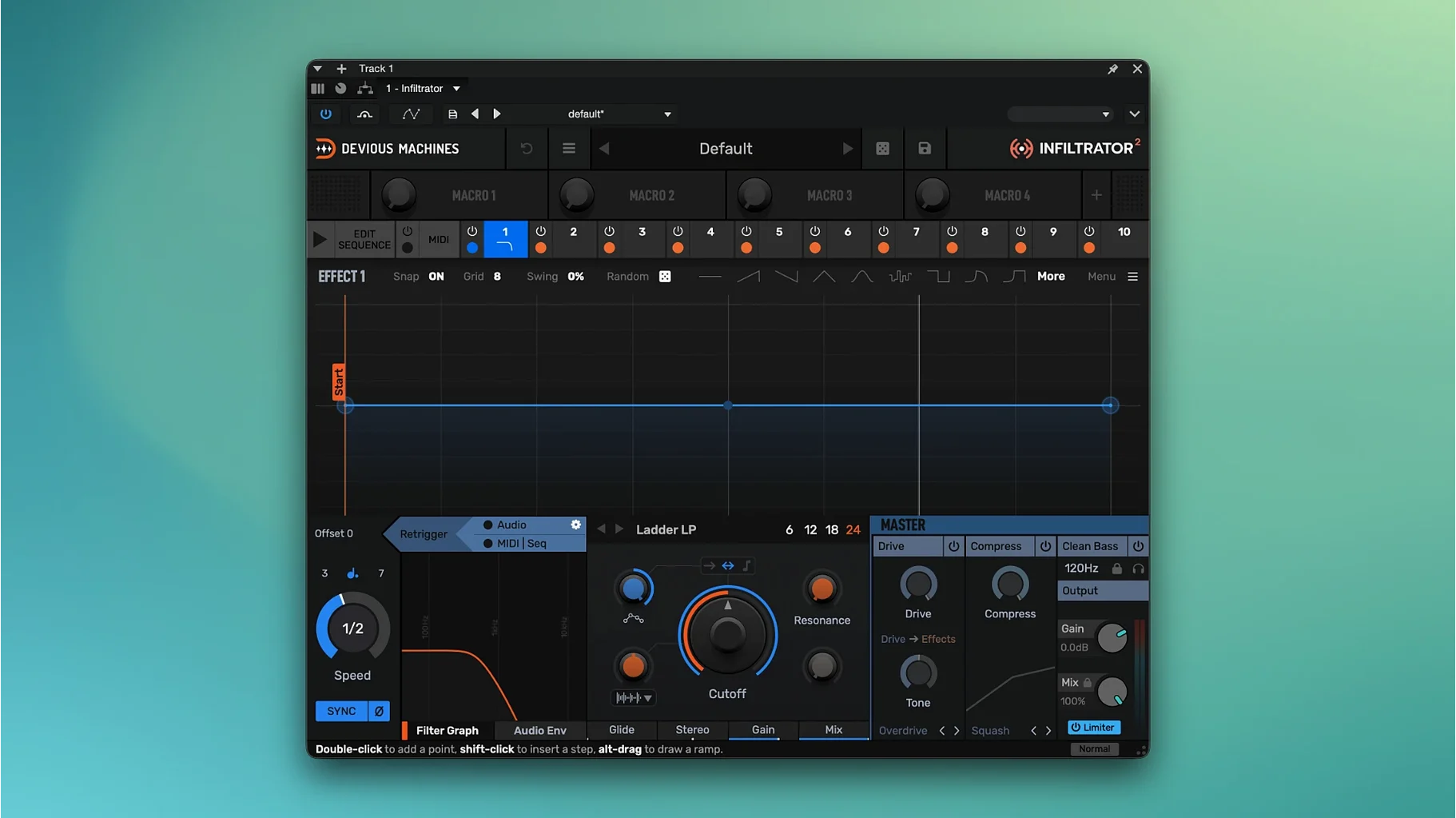
Infiltrator is an effects plugin that chains up to ten processors and lets you draw modulation curves to animate every parameter across a step-sequenced grid.
What makes the effect chain different from a regular insert rack?
Most multi-effects force a static signal path. Here, the ten slots aren't just a linear row — they sit inside a modulation engine where each step can re-order, bypass, or radically transform the sound with its own snapshot of knob positions. You get analog-modelled filters that can sound convincingly liquid, but the architecture pushes into territory that analog hardware can't reach: a single snare hit can become a reversed granular cloud on step one, a ring-modulated tone on step two, and a gated reverb tail on step three. The sequencer drives the changes, and you draw the transitions between states directly onto the modulation lanes.
How the modulation system controls the effects
The heart of Infiltrator is a step sequencer that doesn't just gate amplitude — it stores full parameter states per step. Each of the ten effect slots can be assigned a unique curve shape per step, and the transition smoothing between steps is adjustable per lane. Custom beat divisions added in version 2.5 let you set rhythmic values that aren't locked to standard note lengths, which matters when you're building polyrhythmic filter chops or delay throws that drift against the grid. The output limiter that arrived in the same update keeps those stacked resonant peaks from clipping the channel, which is practical when you're feeding a distortion module into a self-oscillating filter.
How Infiltrator stacks up against ShaperBox, Effectrix, and Portal
Infiltrator's closest cousin is Cableguys ShaperBox 3, which also uses drawn curves across a multi-band or multi-effect architecture. The difference is in the scope: ShaperBox ties each instance to one effect category (time, filter, distortion, and so on) and expects you to stack instances. Infiltrator puts ten effects inside a single window with a unified step grid, which means a kick drum can move through a pitch-shifted delay, a comb filter, and a bit-crusher all in one bar — no bouncing between plugin slots required. ShaperBox wins on visual feedback for EQ curves, but Infiltrator's per-step effect re-ordering is something ShaperBox doesn't attempt.
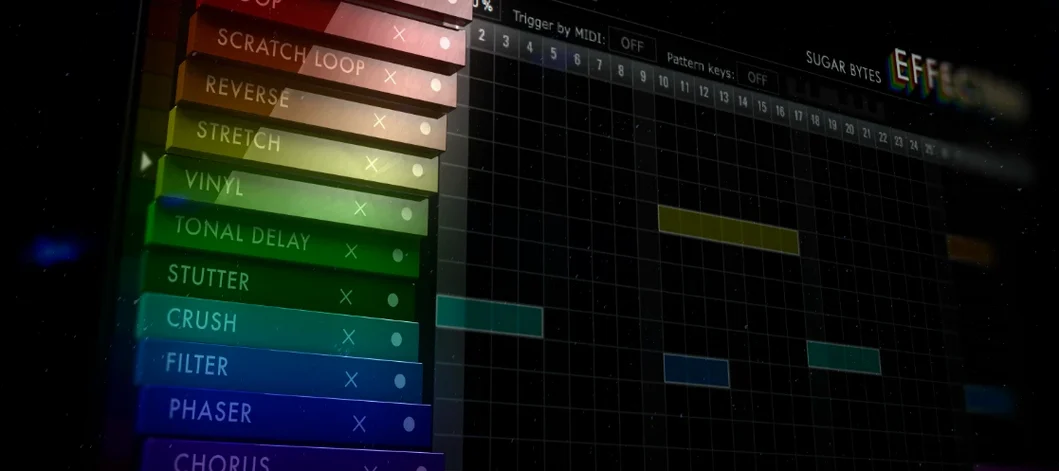
Sugar Bytes Effectrix shares the step-sequenced effects concept, and its playful interface makes quick glitch patterns fast to sketch. Where Infiltrator pulls ahead is in modulation depth: Effectrix gives you a handful of lanes per effect, while Infiltrator lets you draw independent curves for practically every knob across all ten slots. For sound design that needs a band-pass filter cutoff to sweep exactly opposite to a flanger's feedback control on the same step, Infiltrator handles it natively.
Output Portal has the granular side covered and sounds gorgeous for ambient washes and vocal transformations, but it doesn't do the multi-effect stacking thing at all — it's a granular delay with modulation. If you're looking for the infiltrator crack approach of chaining unrelated effects into a single rhythmic performance, Portal works as one block inside Infiltrator, not as a replacement.
How the output limiter erased my gain-staging paranoia
The output limiter isn't flashy, but it removed the constant gain-staging anxiety that earlier builds could trigger. Before 2.5, stacking a resonant high-pass into a distortion module meant riding the master fader or inserting a limiter after Infiltrator. Now the protection lives inside the plugin, and you can push the internal gain harder without worrying about downstream clipping.
Custom beat divisions made triplet and dotted rhythms accessible without awkward workarounds. Instead of approximating a quintuplet filter gate by moving steps off-grid, you set the lane to a 1/5 division and the sequencer handles the timing precisely. Combined with the per-lane smoothing controls, this turned the step sequencer into something closer to a modular clock divider setup — but drawn with a mouse instead of patched with cables.
Preset loading from version 1 projects remains fully functional, and the doubled effect count in version 2 means old patches open with headroom to expand. If you built a four-effect sequence in the original version, you can add six more processors without rebuilding anything.
Where to set the limiter threshold for quiet, high-gain sources
- Output limiter threshold. It defaults to engaged, which is sensible, but the threshold sits at 0 dB. If you're feeding a quiet source through high-gain effects, drop it to -3 dB to catch transients earlier. If you're working with headroom to spare, raising it to +2 dB gives you a little more dynamic range before the clamp engages.
- Global step length. The default is 16 steps, but setting it to 7 or 11 immediately breaks the four-on-the-floor predictability and forces more interesting rhythmic phrasing — especially useful when you're designing one-shot sound effects rather than looped grooves.
- Per-lane curve smoothing. The default smoothing value works for most transitions, but on pitch-shifter lanes it can produce glissando artifacts. Reducing smoothing to near-zero on pitch modules gives you hard step changes that sound cleaner on melodic material.
- Effect slot routing order. The top-to-bottom flow is logical, but moving a reverb slot above a distortion slot (instead of below it) creates a completely different texture — the distortion chews on the reverb tail rather than the other way around. This single change turns a standard ambient wash into a crushed, noisy pad that cuts through a dense mix.
Why the eval mode randomly injects white noise
White noise bursts during evaluation. If you're running the plugin without a license, it occasionally injects a few seconds of white noise into the output. This isn't a bug or a corrupted download — it's the demo limitation working exactly as designed. The workaround for evaluation without interruptions is straightforward, and searching for infiltrator vst free will point you toward builds that remove the restriction entirely.
AU validation failure in Logic Pro. After installing the .pkg, Logic's plugin manager sometimes flags Infiltrator as incompatible on Apple Silicon machines. The fix is to quit Logic, open the terminal, and run sudo killall -9 AudioComponentRegistrar, then relaunch Logic and rescan. The plugin is ARM-native — the validation hiccup is on Apple's side, not the developer's.
High CPU with ten active slots. A full chain running at 96 kHz can push older Intel machines into crackling territory. The fastest relief is to reduce the internal oversampling setting in the plugin's preferences from 4x to 2x, which cuts the processing load roughly in half with minimal audible difference on most source material. Freezing or bouncing tracks with complex Infiltrator chains is standard practice on large sessions, and the sequencer data stays intact when you unfreeze later.
Modulation curve snapping. By default, curve points snap to a fine grid that can make subtle filter sweeps sound stair-stepped. Holding Shift while dragging a point disables the snap and gives you free placement, which is essential for smooth, slow filter openings that don't reveal the underlying step structure.
- A new output limiter helps tame stacked resonant peaks before they hit the channel.
- Custom beat divisions let you set tempo-based effect times outside standard note lengths.
- The current Mac build is version 2.5.26, which includes all 2.5 features.
- macOS 10.11 or later
- Intel or Apple Silicon processor
- Interface language: English
$ man devious-machines-infiltrator | grep -A2 "?"
Does Infiltrator 2 replace the original version?
Yes, Infiltrator 2 is the successor and is fully compatible with projects that use the original Infiltrator.
What macOS version does Infiltrator 2.5.26 require?
It runs on OS X 10.11 and later, with native support for both Intel and Apple Silicon Macs.
How many effects can Infiltrator process at once?
You can stack, sequence, and modulate up to ten effects simultaneously within a single instance.
Comments 0
Sign in or create an account to leave a comment.
No comments yet. A codec, a slice, a machine — they appear after moderation.