Synapse Audio The Legend HZ v2.0.2.R1 for macOS
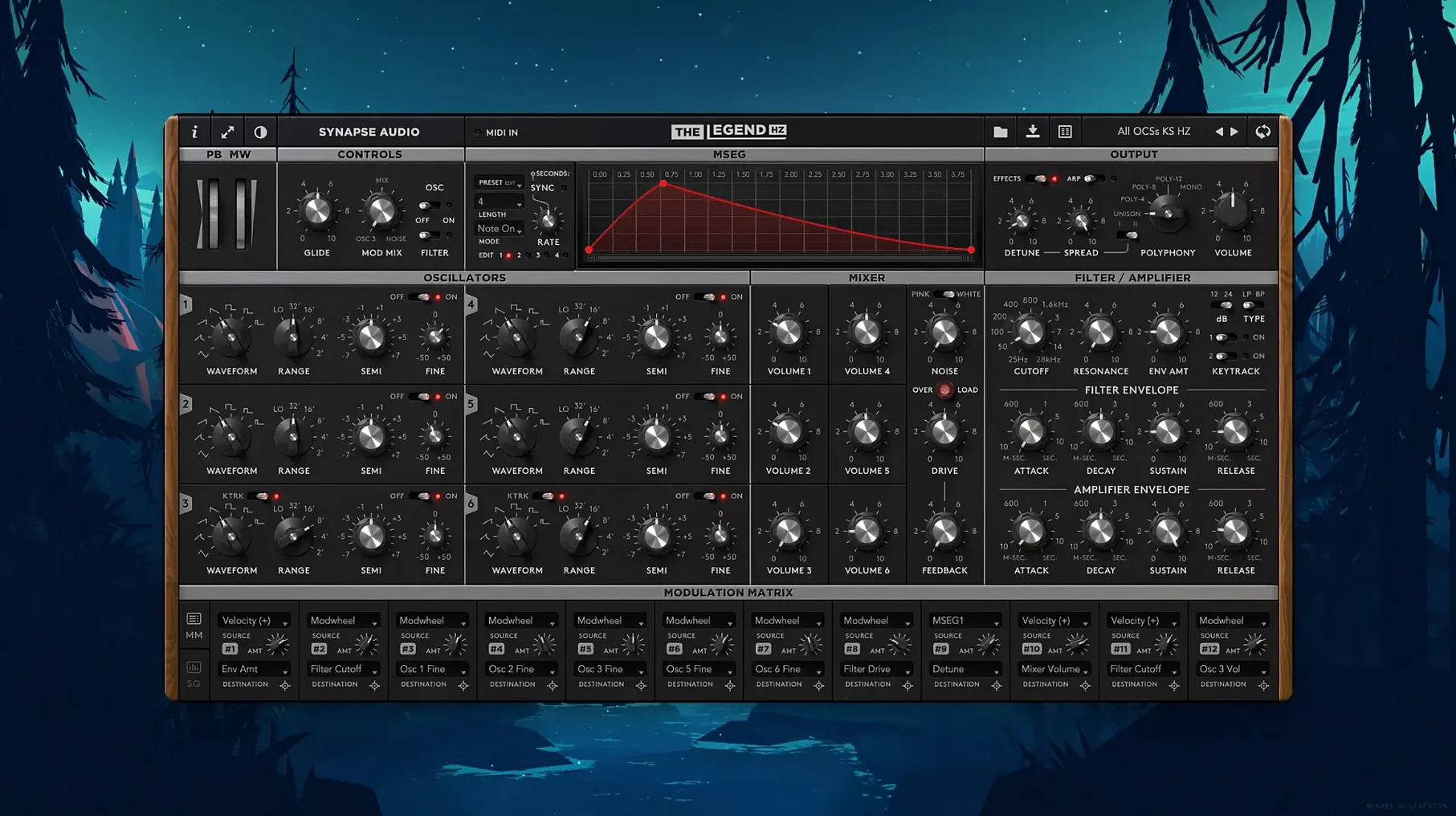
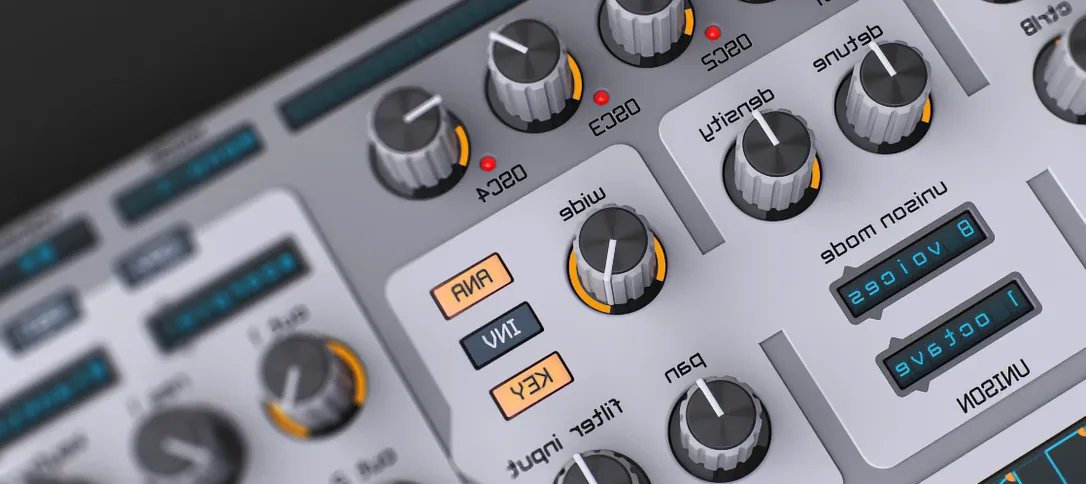
Two hundred factory presets, two legendary sound designers. That's the starting point for The Legend HZ, a software synthesizer that models an analog Minimoog-style signal path with added features its predecessor never had.
What the v2.1 update brings
The back panel now holds a paragraphic equalizer and a compressor saturation stage, giving you tone-shaping tools directly inside the instrument rather than relying on channel strip plug-ins. MTS-ESP microtuning support means you can load alternate tuning tables for non-standard scales. Kevin Schroeder contributed 50 new factory presets on top of the existing 200, joining the original set he and Hans Zimmer created. Unison mode, the 914 Fixed Filter Bank, and the core Minimoog-style voice architecture all carry over from the original release. Projects that referenced the earlier version of The Legend still open it alongside The Legend HZ, so both instruments coexist in your session without breaking old work.
What stayed the same
The synth still runs as a native binary on Apple Silicon and Intel 64-bit Macs, requiring macOS 10.14 or later. The interface remains English-only, and the install process asks you to follow the included instructions for both setup and activation. Underneath, the oscillator and filter modeling stays faithful to the analog circuit behavior that defined the original The Legend — just with a wider palette now that the EQ and saturation live on the back panel.
How it fits into a real production setup
The Legend HZ doesn't try to be a DAW inside a DAW. It sits where a hardware monosynth used to sit: on a MIDI track, fed by your controller, doing one sound and doing it with weight. In Logic Pro I keep an instance on a summing stack track stack, layered under a bass patch from Diva or Repro-1 when I need the low end to hit chest. The 914 Fixed Filter Bank makes it useful as a sound-design insert on audio tracks too — run a drum loop through the sidechain input and sweep the filter bands with automation, and you've got something that feels closer to an old modular processing chain than a typical filter plug-in.
The AU version exposes every automatable parameter to Logic's Smart Controls, so mapping the paragraphic EQ bands or the compressor saturation amount to a hardware knob takes about fifteen seconds. If you use Ableton Live or Bitwig, the VST3 instance reports MPE data correctly per-note, which matters when you're sliding between pitches on a LinnStrument or a Roli Seaboard. One thing to watch: the Arpeggiator/Sequencer section syncs to host transport by default, but if your project sample rate changes mid-session, you'll want to stop and restart playback to re-sync the internal clock — it doesn't chase on the fly.
First days with The Legend HZ: practical notes
- Load the
Hans Zimmer BassandKevin Schroeder Leadpreset folders into separate track stacks before you start tweaking. The HZ folder leans cinematic and dark; the Schroeder folder covers vintage leads, plucks, and arp sequences. Knowing which designer built the patch tells you something about the gain staging and mod routing they favored. - Flip to the back panel on day one and try the compressor saturation with the mix knob around 40% on a bass patch. It fills the low-mid gap that analog-modeled oscillators sometimes leave in a dense mix, without pushing you into full-on distortion.
- If you're coming from The Legend and loading old patches, check the voice count. The Legend HZ defaults to 12 voices; some older monophonic patches sound different at full polyphony. Set the voice count to 1 in the bottom panel if you want the original envelope retrigger behavior.
- Rescan your plug-in folders after installation. The
.componentfile for Audio Units lands in/Library/Audio/Plug-Ins/Components/, and the VST3 goes into/Library/Audio/Plug-Ins/VST3/. If Logic doesn't see it, a full restart of Logic — not just a rescan — usually fixes the AU cache.
How The Legend HZ stacks up against similar instruments
Against u-he Diva, the difference is philosophical. Diva offers three oscillator models, five filters, and a mix-and-match approach to virtual analog; you swap a Roland-style filter for a Moog-style ladder filter on a Jupiter-style oscillator set. The Legend HZ does exactly one topology and does it with zero menu-diving. Diva's Zero Delay Feedback filters ping harder at high resonance, but The Legend HZ's oscillator drift and saturation feel more cohesive at the low end — probably because the whole signal path models one specific instrument rather than several.
Against Arturia Mini V, the difference is the filter bank and the modulation scope. Mini V gives you a modulation matrix, a motion recorder, and effects pulled from Arturia's other emulations. The Legend HZ gives you the 914 Fixed Filter Bank, which is a completely different category of sound-shaping tool. If you're scoring and need to hollow out a pad so it sits behind dialogue without losing presence, the filter bank does it in three bands instead of one parametric sweep. Arturia's synth is broader; The Legend HZ is deeper in the area that film composers actually reach for.
Softube Model 72 is the closest competitor in spirit. It also models a Minimoog-style instrument with MPE support and a small preset library built with one or two high-profile designers. The Legend HZ pulls ahead on polyphony — 12 voices to Model 72's monophonic core — and on the back-panel EQ and saturation, which Model 72 offloads to separate plug-ins. The trade-off is that Model 72's component-level modeling might edge out The Legend HZ by a hair on envelope snap, but that's a matter of taste, not a spec-sheet comparison.
Common mistakes that trip up new users
Loading a polyphonic patch and wondering why the bass disappears in mono. The Legend HZ defaults to 12 voices with no voice-stealing logic that favors the fundamental. If you're writing sub-bass, set the voice count to 1, engage Unison, and use the detune knob sparingly — more than 15% detune on an 808 Hz frequency range will smear the transient. It's not that the synth can't do low end; it's that polyphony changes the envelope retrigger behavior in ways that a mono bass line doesn't want.
Another trap: treating the back-panel EQ like a channel EQ. The paragraphic equalizer sits before the output stage, so boosting 60 Hz by 8 dB drives the compressor saturation harder. That's actually useful once you know it — you can push bass into the saturation without touching the oscillator level — but if you're expecting linear-phase, post-filter behavior, you'll chase your tail on a mix.
Finally, MPE setup. The Legend HZ responds to per-note pitch bend, timbre, and pressure, but your DAW needs to route MPE data to the track before the synth sees it. In Logic, that means setting the MIDI input port to the controller in the track inspector, not just enabling MPE in the synth's settings panel. In Bitwig and Live, it's automatic per-track. If you're coming from hardware and this is your first MPE plug-in, the extra routing step in Logic catches people on the first day.
- Added a paragraphic equalizer on the back panel.
- Added compressor saturation.
- Added MTS-ESP microtuning support.
- Added 50 factory presets by Kevin Schroeder.
- macOS 10.14 or later
- Apple Silicon or Intel 64-bit processor
$ man synapse-audio-the-legend-hz-v2-0-2-r1 | grep -A2 "?"
Is The Legend HZ native on Apple Silicon?
Yes, it ships with native Apple Silicon support alongside Intel 64-bit compatibility.
Does The Legend HZ replace the original The Legend?
No—projects containing The Legend still open the original instrument, so both can coexist in the same session.
What does the v2.1 update include?
Version 2.1 adds a paragraphic EQ, compressor saturation, MTS-ESP microtuning support, and 50 new presets by Kevin Schroeder.
Comments 0
Sign in or create an account to leave a comment.
No comments yet. A codec, a slice, a machine — they appear after moderation.